
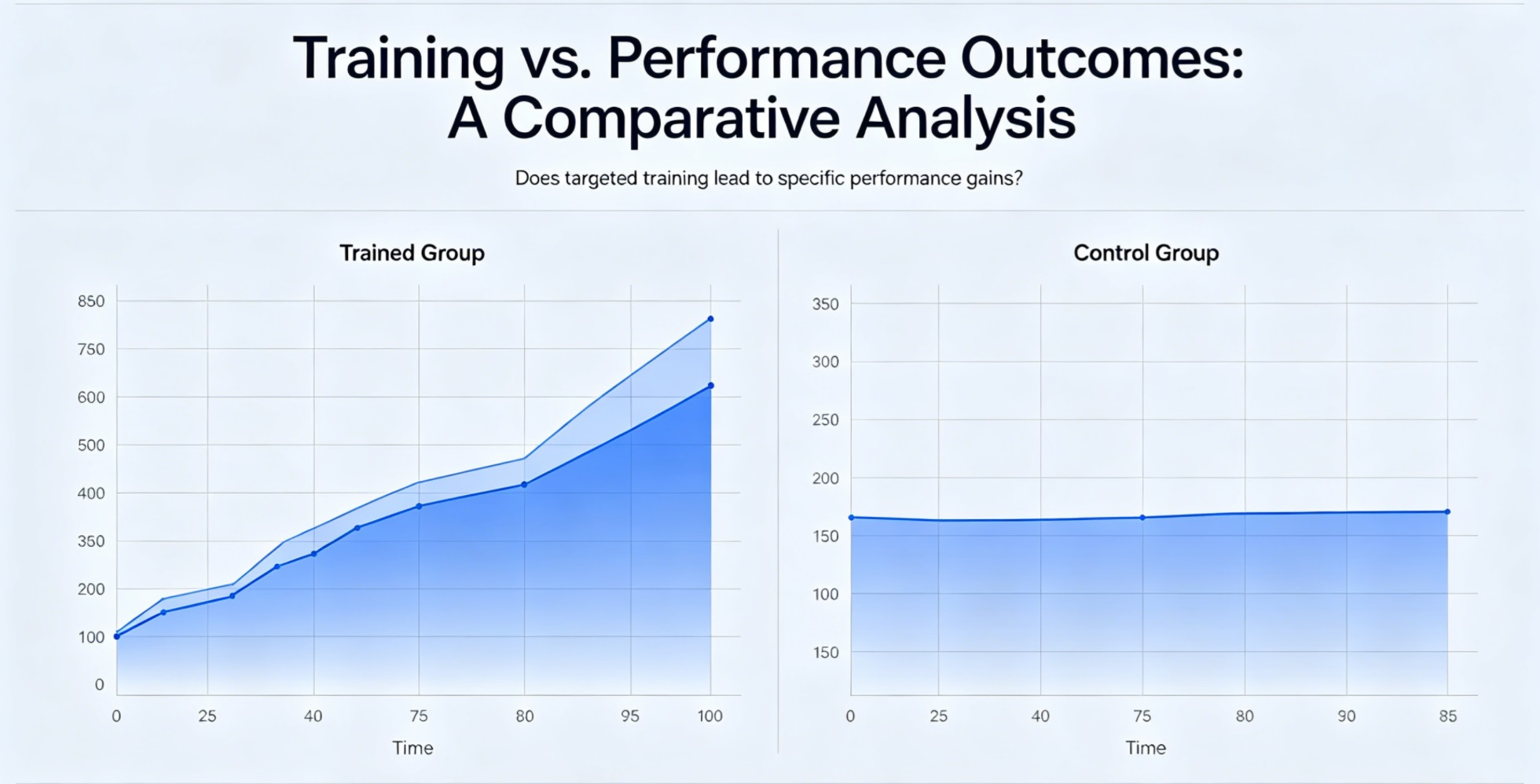
This has long been a debated question throughout history: Can training truly deliver expected performance results? Undeniably, human resource development is an indispensable driver of corporate growth for businesses in both developing and developed economies.
Statistics show that in recent years, U.S. companies have spent an average of approximately 50 billion US dollars on training annually. This staggering figure prompts reflection: Why does such an advanced country attach great importance to human resource development? The same goes for developing economies, where human resources play an even more vital role in corporate growth. Business expansion cannot happen without talented people — much like a state-of-the-art computer that only reaches its full potential and maintains market advantages and competitiveness when paired with sophisticated supporting software.
I believe you would agree that training is essential. Yet many companies face a frustrating problem: Why does training fail to bring about tangible changes and performance improvements? If this issue has troubled you — whether you are a senior HR professional, a business leader or a trainer — you will find practical answers in this article.
You will frequently come across the term performance-based training in the following content. What exactly is it? It is a learner-centric training model focused on tangible outcomes. To draw a simple analogy: Just as a modern Airbus can transport passengers of all nationalities to their destinations faster and more comfortably, performance-based training enables trainers to deliver course content to learners in a more efficient, streamlined and effective way, helping them achieve preset performance goals.
Stage One: Systematic Pre-Training Analysis
A clear definition of the ultimate training goal is the first key to effective performance-based training. When selecting training programs, some companies adopt a casual, haphazard mindset similar to grocery shopping. Their priorities vary: some chase trendy new training "products", others focus solely on cost, many follow industry fads blindly, some expect two-day courses to cover an exhaustive range of content, and a few simply opt for well-known training brands. These considerations are reasonable, but companies must first ask a critical question tied to performance: What is the ultimate goal of this training?
Years of training experience have revealed a common issue: many clients opt for symptomatic solutions due to a misunderstanding of their actual needs. You may wonder how businesses can fail to identify their own problems. This confusion is understandable. In fact, training needs analysis is a specialized skill, much like medical diagnosis by a doctor. When people fall ill, they may buy over-the-counter medicine based on limited knowledge instead of seeing a professional. This often leads to treating symptoms rather than root causes.
Companies face the same dilemma. After conducting systematic pre-training analysis, many clients realize that the fundamental solutions they actually need differ greatly from their initial assumptions. This is a widespread and normal phenomenon, for two main reasons:
1. Being too close to the problem clouds judgment. Even seasoned HR managers can be influenced by daily work stress and emotions, which distort their objectivity in analysis and decision-making.
2. Specialized fields require professional expertise. Choosing a suitable training course may seem simple, but selecting one that aligns with performance goals is a specialized craft. Training needs analysis is entirely different from daily business operations and requires professional expertise and experience. To achieve expected performance outcomes, we must start off on the right foot by having professionals conduct systematic analysis to identify the root causes of problems.
Here is a real-life example. Once, a sales representative from my company arranged a meeting between me and a training manager at a large multinational corporation. After the introduction, he joked and asked if I was eager to meet the manager because of her appearance. Regardless of personal impressions, I always make it a priority to meet clients, understand their real situations and build new connections.
Upon arrival, I learned the company was looking for presentation skills training for mid and senior managers — an area I specialize in. Still, I asked: "Why presentation skills specifically?" The manager replied without hesitation: "To use up the annual training budget." Puzzled, I pressed for details. She explained: The year-end was approaching. If the allocated training funds were not fully spent, the headquarters would revoke the budget, and their training budget for the next year would also be cut. The company simply needed a training program delivered by an international trainer to clear the budget, while offering basic learning to managers.
How could we ensure the client gained real value from this investment? Accepting the assignment hastily would violate the professional ethics of a performance-focused trainer, a mistake I always warn against in my courses. Professional trainers should guide clients to shift from a spending mindset to an investment mindset and help them find fundamental solutions. In other words, we must accurately identify core business challenges, deliver targeted training that drives positive, constructive changes and generates tangible economic benefits.
I launched a series of inquiries and in-depth analysis using our pre-training system to uncover the company’s underlying challenges. The manager cooperated fully but could not pinpoint the core issues at first. After several rounds of discussions, the hidden problems gradually emerged. To my surprise, the company had a far larger workforce than I anticipated, with over a thousand middle managers just in the China region.
These middle managers faced a major dilemma: their hard work and contributions often went unrecognized by headquarters. From the headquarters’ perspective, Chinese managers appeared indecisive. Some stayed silent in meetings and never voiced opinions, while others talked at length without getting to the point. Senior overseas leaders could never truly understand their thoughts. This communication breakdown hindered business development, triggered high turnover among middle managers and caused substantial resource losses, as well as eroded coordination and mutual trust between middle and senior leadership.
Based on this thorough analysis, we redefined the training objectives. The new goals were no longer limited to presentation skills, but expanded to comprehensive workplace communication capabilities for managers — including how to communicate effectively with supervisors, how to make emails stand out in busy inboxes, and more. We also categorized training content into two tiers by priority: core essential skills and optional advanced skills.
Parts of the original presentation skills content were moved to the second tier, while irrelevant modules were removed. We added practical modules covering cross-cultural communication, structured opinion delivery, communication frameworks, questioning and listening skills, and techniques to enhance persuasive influence during presentations.
The training manager grew enthusiastic about the revised program, which now carried genuine practical value. I later learned that multiple training proposals were already on her desk when we met. Our quotation was even several times higher than others, yet the company chose us. The key reason was that we delivered a viable investment solution, clearly demonstrating how the training would generate performance gains and returns — value that far outweighed the price gap. After the program concluded, the manager gave excellent feedback and invited us to deliver phased training for more managers in the following year.
This experience reinforces a timeless truth: Doing the right thing matters more than doing things right. By conducting systematic analysis at the very start and truly understanding clients’ core needs, we create value for clients and earn reasonable returns for ourselves. A good start is half the battle won.
Key takeaway: Clarify the ultimate training goals, find fundamental solutions and address problems at their source.
Stage Two: Performance-Based Training Systems and Techniques
Training is not just lecturing. I once met an experienced senior trainer in Shenzhen. We shared many common views, with one main difference: he served as Chief Trainer at a large enterprise, while I work independently as a roaming professional trainer. We talked about my certified professional trainer courses, where many participants are also seasoned trainers. These veterans, armed with rich experience and expertise, still approach learning with humility and an open mind to upgrade their training capabilities.
Interestingly, many people who used to be called "trainers" are actually just lecturers. When my new friend asked why, I explained with an example: One participant specialized in team building. He shared his experience and showed photos from his past sessions. From the photos, I noticed all seating arrangements were set up for traditional classroom lectures — meaning he still relied heavily on lecturing even for team-building training.
"If not lecturing, how do you run training sessions?" he asked eagerly. I replied: "Lecturing has its place, but it is not suitable for all training scenarios." I then asked who his typical participants were. He answered: "Adults at all levels — managers, supervisors and frontline employees."
"Have you noticed participants being distracted during sessions, or forgetting almost everything shortly after class?" He nodded in agreement. "The problem is not your content or preparation. The issue is that participants lack the willingness to learn, making all your efforts futile."
"How can we change this?" he asked. I took a sip of water and continued: To achieve training performance goals, trainers must understand adult learning psychology and master eight core principles:
1. Calm participants’ minds
A strong opening is critical for any training, especially for settling participants’ minds. When adults enter a classroom, they are usually preoccupied with unfinished work, family matters, worries about peers or doubts about the trainer. Their minds are as cluttered as rush-hour traffic. Trainers must address these unspoken concerns at the opening to help participants focus. Though often overlooked, this step lays a solid foundation for smooth training delivery.
2. Stimulate learning motivation
Adults need motivation to learn. For in-company training, many participants attend reluctantly — due to managerial orders, mandatory training credits, a desire to escape heavy workloads, or even treating training as a leisure trip. Their minds are closed, like tightly sealed bottles that cannot take in new content.
Motivation comes from within. The English word motivation combines motive and action. Trainers must help participants identify their personal learning motives and create a positive atmosphere to drive active engagement.
3. Respect adults’ independent thinking
Adults rarely accept ideas imposed on them, but they readily embrace answers they discover themselves. Therefore, trainers should ask guiding questions more and talk less. In performance-based training, success is measured not by how well the trainer speaks, but by how much participants change and apply what they have learned after class. Trainers act only as guides and facilitators.
4. Understand adults’ limited attention span
Statistics show that most adults lose focus significantly after 20 to 30 minutes of passive listening, and their knowledge absorption drops sharply. Even for academic courses, interspersing interactive activities can greatly boost engagement, absorption and memory retention.
5. Awaken the inner child
Every adult retains a childlike, playful side. In competitive workplaces, especially among managers, professionals and business leaders, people tend to suppress their passion and emotions to maintain a professional image — just like grown cats that stop exploring and playing. This mental barrier blocks learning. Trainers should use interactive activities to reawaken this lively side quickly.
6. Shift participants to active learning
As an old saying goes: What I hear, I forget; what I see, I understand; what I do, I remember. Research shows adults can speak 110–160 words per minute, yet think at 400–500 words per minute. This gap leaves room for distractions. Interactive activities turn participants from passive listeners into active thinkers, bringing them a strong sense of achievement and further motivation.
7. Adopt differentiated approaches for different training levels
Training can be divided into three levels, easily remembered by the acronym ASK: Attitude, Skills and Knowledge.
Different levels involve different participant backgrounds, learning content and objectives, and thus require tailored training methods. Trainers need to adjust flexibly based on learning demands:
- For high-level training: Focus on targeted information delivery, guiding participants to embrace new concepts and develop constructive solutions independently.
- For grassroots-level training: Prioritize knowledge transfer. Activities are designed mainly to sustain attention and improve information absorption.
8. Deliver a powerful closing summary
Many trainers rush through or even skip the closing summary due to time constraints, ending classes with a brief remark or just distributing feedback forms. Yet the opening and closing are what participants remember most vividly.
A strong summary reinforces key takeaways, bridges learning and real-world application, and inspires immediate action. A poor summary wastes all previous efforts — much like telling a wonderful story without a proper ending, leaving the audience with nothing meaningful. A thoughtful closing is therefore indispensable.
Related models: Experiential Training, Accelerated Learning, and the Think-Feel-Act® learning framework.
Stage Three: Post-Training Implementation System
Learning fuels action, but only action creates real results. Knowledge alone achieves nothing without application. Post-training implementation is the most critical yet challenging stage.
In the first two stages of performance-based training, trainers can take full initiative. However, post-training execution lies beyond trainers’ direct control, and various external obstacles may derail implementation:
1. Lack of managerial support: When participants return to work and try to apply new ideas, supervisors may fail to recognize their enthusiasm and offer support — either due to poor communication or misunderstanding. Without backing, new plans will fail.
2. Gradual forgetting: After days away from work for training, participants face piles of pending tasks. They put new learning aside, and eventually forget implementation plans amid busy schedules.
3. Practical challenges: Participants may encounter difficulties when applying new methods, leading to abandoned plans.
So, what solutions can trainers use to guarantee training outcomes under such constraints? Two proven, practical strategies:
1. Distribute action plans during class: Each plan includes key learning points, specific implementation steps and review dates. Participants record takeaways in real time, while managers gain clear visibility into what employees have learned and their implementation intentions.
2. Extend training beyond the classroom: Provide regular follow-up reviews, supervision, assessment and coaching after the course. This tracks implementation progress and prevents participants from feeling isolated. With ongoing support, learners become more willing to embrace challenges, break limits and achieve growth. This explains why post-training coaching systems have grown popular in recent years.
A maxim: Learning without practice is futile; practice without results is wasted effort.
Conclusion
In today’s fast-paced 21st-century business landscape, training is universally recognized as essential for both market leaders and growing enterprises. Training that delivers measurable performance has become a universal demand.
After reviewing the above practical insights, you now have a clear understanding of performance-based training and its value. To recap its three core pillars:
1. Conduct systematic pre-training analysis to identify core business needs and deliver fundamental solutions.
2. Apply professional performance-based training methodologies to drive active learning among participants.
3. Provide supporting tools and supervision systems to ensure sustained behavioral changes after training.
A common misconception is that learning ends the moment a course finishes. This is not true for performance-based training. True learning is completed only when participants achieve tangible, positive changes. As emphasized before: Learning without practice is futile; practice without results is wasted effort. For this reason, performance-based training requires participants to go one step further: master knowledge in class, apply it at work and reach preset goals — only then is learning truly complete.
Many participants in our international professional trainer courses are HR managers, business leaders and industry professionals. Some aim to turn their experience and expertise into a fulfilling long-term career through training, doing work they love and find valuable. Others want to pass on their knowledge and skills to colleagues and successors effectively. Many more hope to master scientific training selection methods to solve business problems and boost corporate performance.
If you belong to any of these groups, I encourage you to explore performance-based training further. This skill will not only help you stay competitive and improve work efficiency but also become a lifelong asset — potentially opening doors to a lasting, rewarding career and a life-changing opportunity.
For in-service trainers, mastering performance-based training techniques is the key to standing out in the competitive training industry. It elevates your professional value and brings more substantial income. Always remember, performance-based training is built on an investment mindset. People are always willing to invest more when they see clear returns.
Trainers dedicated to this industry should fully master performance-based training systems and techniques. They will not only deliver expected performance results for clients but also reap well-deserved rewards for themselves.