South Talent: A Discussion on Eastern and Western Human Resource Management
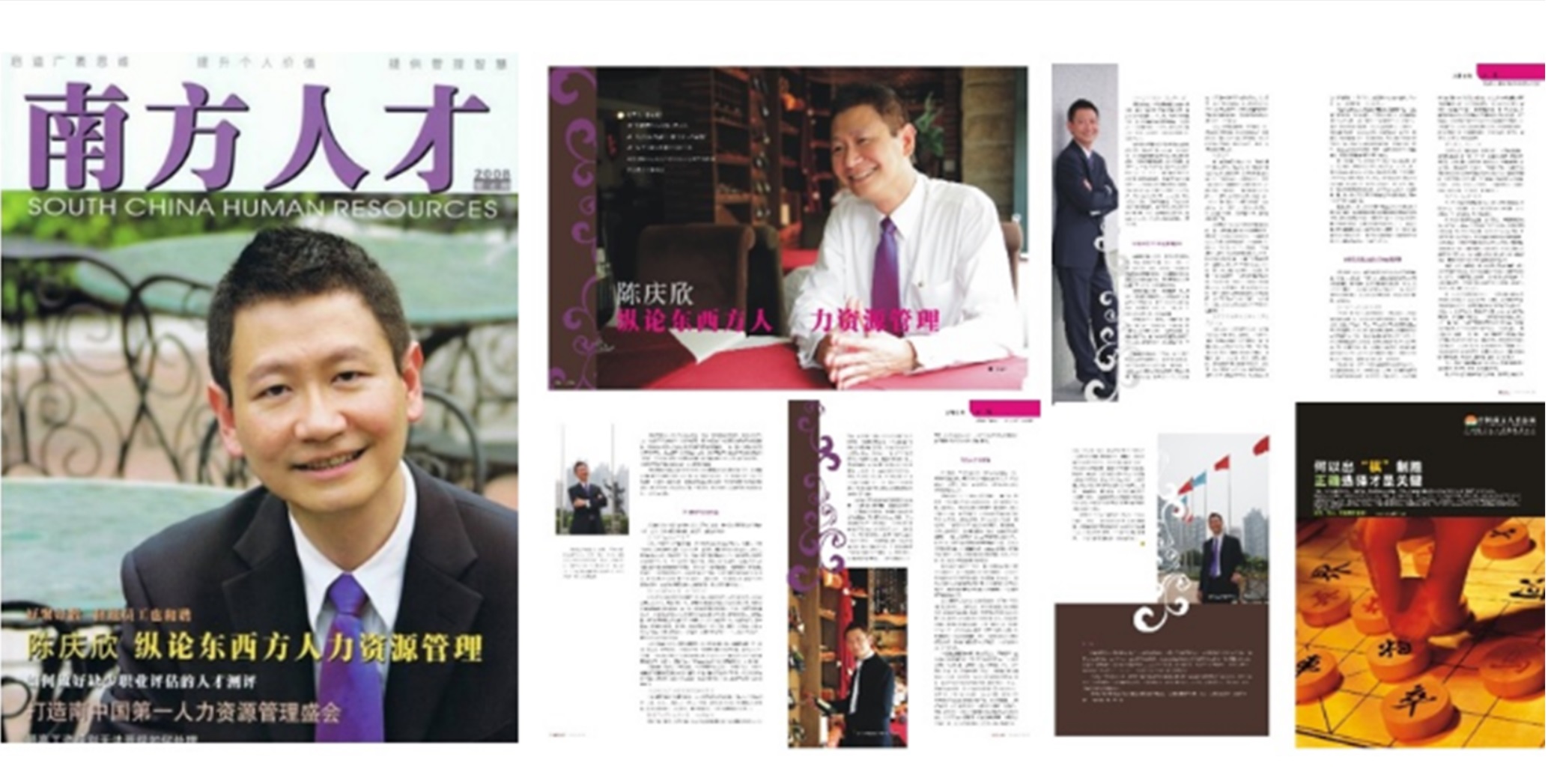
August 21, 2008 | South Talent Magazine | Reporter: Liang Ruiling | Interviewee: James Chin
In a cover interview for South Talent Magazine in southern China, Mr. Chen Qingxin, CEO, Chairman and Founder of ICT, was invited to share insights on the critical role of human development in enterprises’ sustainable growth and expansion.
James Chin Discusses Eastern and Western Human Resource Management
Our featured guest for this issue is a foreigner fluent in Mandarin, whose gentle and refined demeanor is immediately apparent. As one of the Asia-Pacific’s leading internationally certified professional trainers, presentation coaches, business management consultants and executive mentors, he remains remarkably approachable and down-to-earth. He is the distinguished figure we closely follow—Mr. James Chin.
His unique teaching style profoundly benefits participants. Additionally, with his discerning vision and sharp analytical skills, he has helped numerous small and medium-sized enterprises break through bottlenecks. Decades of extensive professional experience and a solid Western educational background equip him with both the integrity of an exceptional professional manager and the wisdom of a cultured business leader.
He possesses not only a profound foundation in management theory and hands-on experience in standardized enterprise management but also expertise in domestic and international corporate management and consulting. A professional trainer who has grown from practical management roles in multinational corporations, he boasts over 20 years of diverse experience in multinational management, consulting and training.
He serves as a mentor to mid- and senior-level leaders at many Fortune 500 companies and industry leaders and also trains numerous renowned international trainers. He has certified over a thousand professional trainers across China, Singapore and Malaysia. He is the only practical management consultant and executive coach who integrates Eastern and Western corporate cultures, blending Eastern wisdom with Western management philosophies to their fullest potential.
Corporate Challenges in the 21st Century
Recently, manufacturing enterprises in the Pearl River Delta have faced severe talent attrition. Rising costs and external factors driving down sales prices have threatened the survival of many low-margin industries.
Can Relocating Operations Solve the Problem?
In response, some enterprises have moved inland, while others have shifted to Vietnam or other regions. But will relocation truly address the root cause? Chen Qingxin believes this is an inevitable stage of social progress and prosperity for any country or region. Business owners seek growth, and employees aspire to better lives.
Societal advancement—from rural to urban living, cycling to motorbikes to cars, shared housing to private homes—naturally drives up operational costs.
This universal desire for progress exists everywhere, sooner or later. Treating relocation as a panacea, economists argue, merely “exports the problem.” Even after moving, rising workforce quality will eventually lead to higher costs again—a temporary fix, not a permanent solution.
Enhancing Efficiency: The Only Sustainable Solution
The key lies in improving enterprise efficiency, not suppressing employees’ growth aspirations. This is akin to managing floods: blocking works only temporarily, while channeling water to where it is needed is the optimal strategy. A motivated workforce with growth ambitions is goal-oriented, driven and easier to inspire.
As labor costs rise, enterprises must evolve from labor-centric to capital-centric operating models. Employees’ contributions will shift from manual labor to intellectual, human-centered thinking. In this new paradigm, if one employee can perform the work of two—faster, simpler, more effectively—even with a 50% salary increase, employers pay less (1.5 salaries instead of two). Costs decrease, and both employers and employees benefit.
This mirrors the experiences of other advanced economies, including Japan, South Korea and Singapore. In the 1980s, Singapore faced identical challenges: rising costs drove foreign investors to Malaysia, Indonesia and Thailand. Yet these “fleeing” enterprises eventually returned to Singapore. Why?
The answer lies in sustained human resource development. The Singaporean government established a Productivity Board to advise enterprises on productivity and growth challenges. Through operational restructuring, training, and workforce upskilling, Singapore quickly regained its competitive edge.
HR’s Pivotal Role in Boosting Productivity
Human resources (HR) play a critical role here. Misaligning HR functions demoralizes teams and risks losing top talent. Just as rigorous officer training is vital for battlefield success, enterprises must systematically develop HR capabilities.
To support technical professionals transitioning to managerial roles, James Chin recommends assessing alignment between human resource development and organizational needs. Prioritize upskilling in areas like business communication, influence, persuasion, leadership and emotional intelligence.
Education as the Foundation of Nation-Building
Ancient Chinese wisdom states: “To govern a nation and its people, education comes first.” This reflects an early recognition of the inseparable link between teaching and learning. As the saying goes: “Teaching without learning is futile; learning without application is wasted; application without results is meaningless.”
Chen observes a common trend in Chinese corporate training: overreliance on lecture-based instruction. Research shows that adults retain only 6.25% to 12.5% of information from lectures after 24 hours. As Confucius famously said:
“Tell me, and I will forget. Show me, and I will remember. Involve me, and I will learn.”
Achieving Training Effectiveness
Effective training depends on its objectives, which fall into three core levels:
During an international professional trainer program, a senior team-building coach shared photos of his workshops. James smiled gently, prompting the coach to ask for feedback.
James replied: “Have you noticed participants get excited in workshops but take no action afterward?” The coach nodded, surprised. James explained: “Your classroom setup reveals a lecture-focused approach—but team building is a mindset-based training. Lectures inspire, but they are not enough. You need interactive activities, guided reflection, questioning, and action tools to drive lasting change.”
In short: Knowledge aims for understanding, skills for proficiency, and mindset for insight.
James’s decades of global training experience highlight key differences between Eastern and Western practices:
James Chin emphasizes there is no “right” approach. As Deng Xiaoping said: “It doesn’t matter if a cat is black or white, as long as it catches mice.” Effective training meets two goals: organizational objectives and measurable behavioral change. His book, Is Training Truly Able to Achieve Targeted Performance Outcomes?, explores this in depth.