
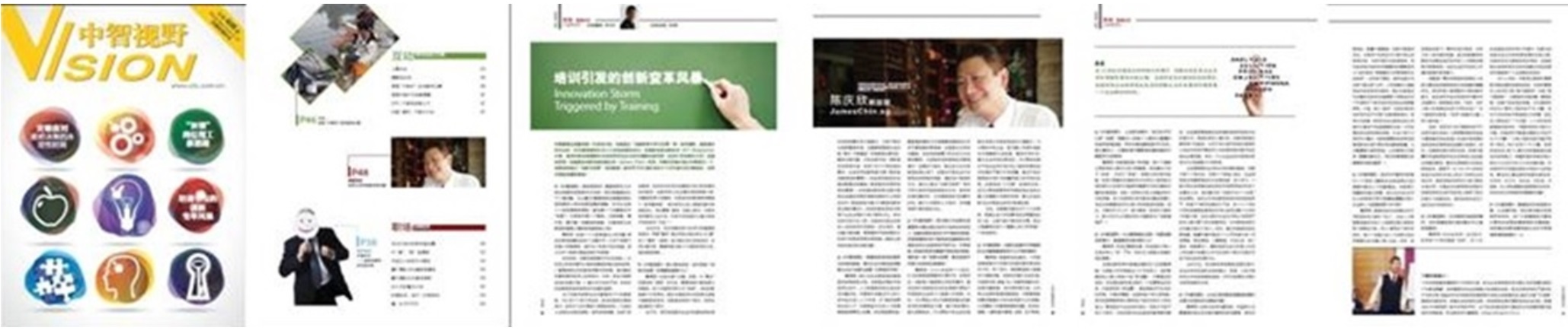
Vision: The Innovation & Transformation Wave Driven by Training
November 22, 2011 | CIIC Vision Magazine | Reporter: Zhang Yue Han | Interviewee: James Chin
Our guest for this exclusive interview is a master trainer. Through courses themed Innovation, Transformation & Learning Development, he has helped numerous renowned enterprises, outstanding managers and professionals achieve breakthrough growth. He is Chairman of ICT Singapore, former President of the International Professional Trainers Association (Singapore), and a mentor for executive programs at top Chinese business schools including Peking University and Fudan University. This distinguished guest is James Chin from Singapore.
In this feature, we explore how his training on innovation and transformation helped a Fortune 500 company save 5 million US dollars within six months and uncover the secrets behind this remarkable achievement.
1. CIIC Vision: Hello, James. Thank you for taking time out of your busy schedule for this interview. We have prepared ten questions to help HR practitioners and professional managers gain deeper insights into innovation and transformation and support the growth of both organizations and individuals. To start with: innovation is often seen as an abstract concept, intangible and hard to grasp. Based on your experience, how can ideas from innovation training be translated into tangible business results?
James Chin: This is a question many people care about. Four core links are essential to turn innovation into practice: Awareness → Skill Building → Implementation → Hands-on Practice. They are like the four legs of a table — the whole structure will collapse if anyone is missing.
The value of hands-on practice cannot be overstated. Let me share a real story. After one innovation training session, a mid-to-senior manager told me: “I have attended similar courses before. The instructors delivered excellent lectures and shared plenty of case studies, but I always found it hard to apply the ideas to my actual work. My learning stayed at the conceptual level, and problems remained unsolved. Your training, however, is like a ‘mental fitness studio’. From the very start, participants examine their own work, identify areas to improve, and master your tools and methodologies. Within just two days, everyone can finish practical assignments and truly learn to apply what they have gained.”
This proves that knowledge and skills must go hand in hand with hands-on practice. You will never get fit just by watching others work out. Likewise, learners need to fully engage with every innovation thinking tool, keep practicing, and find practical solutions on their own.
2. CIIC Vision: What are the typical backgrounds and driving factors for enterprises to adopt innovation and transformation initiatives?
James Chin: Let me use a metaphor. From the emergence of innovative ideas to the delivery of tangible results, continuous nurturing is required — and this nurturing process is exactly transformation. Innovation and transformation are inseparable, just like waves and water. Innovation is part of transformation, and transformation also fuels innovation.
In recent years, we have seen a sharp rise in demand for relevant training and consulting among Chinese enterprises. Common scenarios include corporate mergers & acquisitions, internal restructuring, pursuit of aggressive growth targets, tackling new challenges, exploring new markets and rebuilding competitive edges.
These demands fall into four phases:
Training objectives generally fall into three categories: creating valuable new products and services; optimizing existing workflows, products and services to cut costs and build advantages; and solving unprecedented new problems.
3. CIIC Vision: From your training and consulting experience, what are the differences between Chinese enterprises and those in other Asian countries when it comes to innovation and transformation?
James Chin: The gap mainly lies in managers’ mindset shifts. In a fast-growing market economy, human resources are fundamental to business success. Although millions of university graduates join the workforce every year, recruiting the right talent remains a major headache for HR teams.
A common quick fix is to hire experienced managers from other companies with higher pay. However, these professionals bring with them different corporate cultures. When they take up decision-making roles, cultural conflicts inevitably arise — a prevalent and unique issue among Chinese businesses.
Training on innovation and transformation can help employees view problems objectively, shorten the adaptation period for new team members, reduce unnecessary turnover, and build a unified and harmonious corporate culture.
4. CIIC Vision: Many assume innovation is limited to technical roles and R&D departments. Yet you have served clients across diverse industries and job functions. Could you talk about whether innovation and transformation apply to all sectors and positions?
James Chin: This is a widespread misunderstanding. Innovation is not exclusive to technology. It is a systematic way of thinking that boosts efficiency for organizations and individuals across all fields.
For example:
To draw an analogy: innovative thinking is like the skeleton of a human body. With tailored tools and continuous refinement, every enterprise can develop its own unique strengths, characteristics and value.
5. CIIC Vision: What distinct benefits can innovation and transformation bring to managers at different levels?
James Chin: Expectations vary by role.
6. CIIC Vision: It seems innovation is a practical thinking skill that everyone can master, rather than an abstract talent. So does one need an innate creative mind to be innovative?
James Chin: Innovation is a learnable skill. Anyone with normal thinking ability can master it. The key is not natural talent, but readiness to learn.
In my training experience, many engineers who are used to logical, left-brain analysis can grasp innovative thinking methods and work out creative solutions within two days. On the contrary, even highly creative salespeople will fail to learn this lifelong skill if they resist new approaches.
As long as you stay open-minded, willing to try and keep practicing, anyone can become an innovation architect.
7. CIIC Vision: What are the most common challenges for corporate managers during innovation, reform and rapid business expansion?
James Chin: Two key points deserve attention: calming team members down and setting a clear shared vision.
Employees, especially those with 8 to 10 years of service, tend to stay in their comfort zones and resist changes. When the status quo is disrupted, they feel anxious, doubtful and uncertain. Such negative emotions will severely undermine execution, creativity and team trust, leading to low morale and talent loss.
To minimize risks, senior leaders must communicate thoroughly before rolling out changes, helping employees understand that innovation and transformation are inevitable and necessary. Teams also need to be equipped with corresponding skills. Many enterprises invite external professional trainers to deliver neutral guidance for better results.
Leaders must also recognize that innovation is a journey, not a final destination. It requires long-term commitment.
I worked with a foreign enterprise aiming to secure market leadership and prepare for an IPO. They understood innovation is an ongoing process. With our training support, they launched phased innovation initiatives over 6 to 12 months to embed innovative mindsets into daily work. Training was provided for all staff from top management to frontline employees. An innovation committee was set up to supervise and advance six core work streams: marketing, operation, HR, R&D, customer service and strategy. Eventually, innovation became part of everyone’s routine and the company’s core culture.
In short, during transformation and rapid growth, enterprises must pay close attention to employees’ capabilities, mindsets and emotions, and offer sustained support for long-term behavioral changes.
8. CIIC Vision: What key issues should enterprises prioritize when leveraging innovation to drive rapid growth?
James Chin: Above all, stay focused on the ultimate goals and vision. Clear objectives help concentrate efforts and ensure innovation delivers real outcomes.
Before a training program for a foreign company, I talked with its China General Manager and asked what results he hoped to see. He replied: “I want managers to start thinking proactively.” I later learned the company had suffered losses for five consecutive years, and the core expectation was to get employees thinking about profit growth. Their previous training failed simply because this core goal was not clearly communicated.
I designed the whole program centered on profitability. The effect was remarkable. Participants developed practical profit-boosting plans, the company’s performance turned around quickly, and everyone was highly motivated.
As management guru Peter Drucker put it: Doing the right things matters more than doing things right. A clear vision helps managers prioritize wisely and create maximum value.
9. CIIC Vision: Your Certified International Professional Trainer program, co-launched with CIIC, integrates innovative concepts and has won wide market recognition. What core ideas can corporate HR teams learn from this program to upgrade talent development work?
James Chin: The program’s success comes from the team’s dedication. To make talent development effective, HR professionals must also devote genuine care to their work and avoid training for the sake of training.
Meaningful talent development starts with identifying the real needs of the enterprise, employees and end clients. We infuse real value into learning and use innovative teaching methods to help HR teams elevate their work, build a stronger sense of achievement and purpose.
Keeping pace with changing demands and continuous innovation is the secret to the program’s long-term vitality. We upgrade every session constantly. Many alumni come back to work as teaching assistants and often ask: “Why do we always learn something new here?” I always quote the saying: You cannot step into the same river twice.
The program was originally designed for HR professionals and senior managers planning retirement or career transition. Yet the transfer of thinking and wisdom has brought far-reaching changes to participants. Statistics show only 10% to 15% of graduates become professional trainers. Most others achieve remarkable promotions and career breakthroughs in their original roles, thanks to upgraded thinking and innovative vision. This training has become a turning point in their lives.
10. CIIC Vision: Finally, do you have any advice to share with our readers?
James Chin: For enterprises: The only constant in the world is change. In the rapidly evolving marketplace of the 21st century, innovation and transformation are essential for survival and sustainable development. Taking the initiative to change is always better than reacting passively. Every enterprise should strive to build a flexible, adaptive ecosystem for growth.
For individuals: We all face obstacles in work and life. Instead of asking “Can I do this?”, ask “Is this worth doing?”. If something is valuable, focus your thinking and you will find solutions.
Take Ford’s V6 engine development as an example. At that time, it was deemed technically impossible. When engineers said it could not be done, Henry Ford responded: “I don’t want to hear ‘impossible’. Tell me how we can make it work.” After a week of intensive brainstorming, the V6 engine was successfully invented.
Your mindset shapes your destiny. The greatest asset each person owns is their thinking capacity. Scientists have found that most people use less than 10% of their mental potential. Keep exploring your strengths, think innovatively, and create a better future for yourself, your enterprise, society and humanity. You will surely be proud of what you accomplish.
CIIC Vision: Thank you, James Chin, for your wonderful sharing. Starting from this issue, we will launch a special column for you, where you will share your rich experience in innovation and transformation, and practical approaches to help enterprises achieve breakthroughs across various fields. Stay tuned to James Chin’s Column in CIIC Vision.