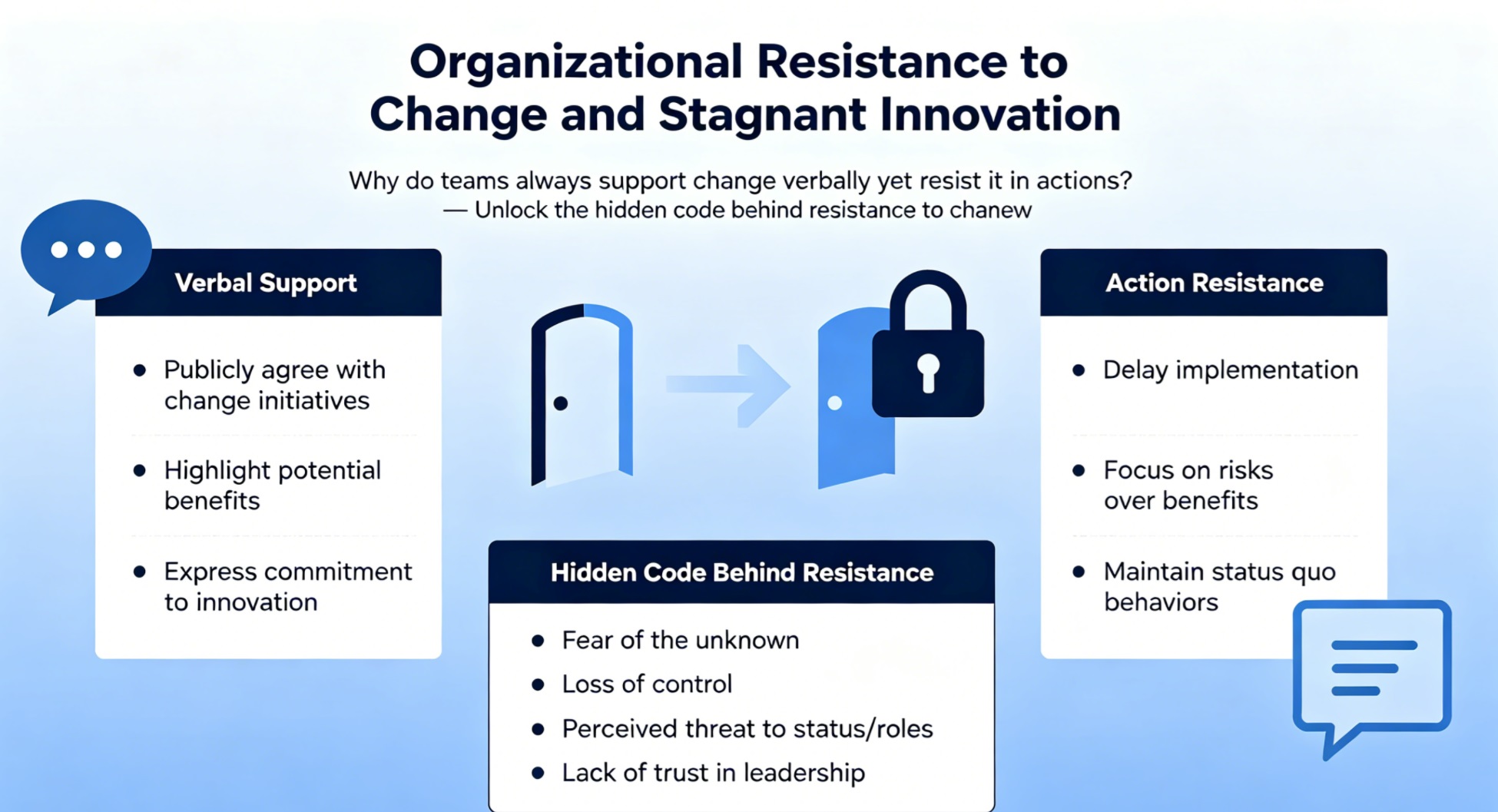
Organizational Resistance to Change and Stagnant Innovation
Why do teams always support change verbally yet resist it in actions? — Unlock the hidden code behind resistance to change
I. Do These Dilemmas Sound Familiar?
"Every time a new strategy is announced, silence fills the meeting room. I know what everyone is thinking: 'Here we go again, another round of adjustments.' Three months later, the new plan fizzles out, and everyone slips back into old routines."
"The company invested millions in introducing cutting-edge AI tools and providing relevant training. Yet staff still stick to old working methods. Young employees use the new tools privately, while senior workers refuse to adopt them entirely. All the investment goes down the drain."
"While competitors keep innovating, we also advocate for innovation. But all we deliver are minor tweaks. None of our initiatives can reshape the industry landscape."
If you relate to these scenarios, your organization is facing the most covert yet fatal challenge in transformation: passive resistance driven by organizational inertia.
II. Three Barriers to Change — Which One Is Holding Your Organization Back?
Barrier 1: Perceptual Inertia — Teams Fail to See the Need for Change
Phenomenon: You identify industry trends and potential crises, yet the team believes "We’ve always done it this way, and it works fine." They treat your warnings as mere stories.
Result: Change becomes a one-man show led by leaders. Team members cooperate superficially while resisting deep down.
Barrier 2: Rigid Mindset — Teams Cannot Imagine New Possibilities
Phenomenon: When innovation is required, proposals are always limited to "polishing our old practices".
Result: Innovation stays at the stage of incremental improvement instead of disruptive breakthroughs. The long-awaited second growth curve never takes shape.
Barrier 3: Behavioral Inertia — Teams Fail to Deliver Real Change
Phenomenon: Employees get inspired during training, but revert to old habits back at work. New methods are deemed cumbersome, while familiar routines remain the first choice.
Result: Transformations start with great fanfare but end weakly. Massive resource input brings no tangible returns.
III. Unspoken Frustrations of Change Leaders
Pain Point 1: Isolated Transformation Efforts
"I am the biggest advocate for change in the company, but the whole team just waits passively. I have no idea how to motivate them, let alone turn individual initiative into collective action."
Pain Point 2: Empty Innovation Slogans
"We talk about innovation year after year but never achieve real breakthroughs. The team claims they are doing their best, yet the gap between us and competitors keeps widening."
Pain Point 3: Failure to Embrace the AI Wave
"AI is widely adopted across the industry, but our team feels fearful and resistant. I don’t know how to help them move from fearing AI to mastering it."
Pain Point 4: Burnout from Continuous Change
"We have pushed forward transformations for three years, and now the team is worn out. Whenever new initiatives are proposed, their first reaction is "Not again." I struggle to reignite their passion."
IV. Why Conventional Solutions Fall Short
|
Conventional Approaches |
Ineffective Performance |
Root Causes |
|
Issuing documents & holding mobilization meetings |
Employees understand change is required, but not why change is needed, how to implement it, or what it means for them personally. |
Only information is delivered, not the core value behind change. Transformation is viewed as the leader’s task, not the team’s shared mission. |
|
Deploying external AI tools |
Tools are purchased, yet employees refuse to learn or use them. |
Teams lack mental readiness. They are forced to act before they fully accept the necessity of change. |
|
Innovation contests & idea collection campaigns |
Numerous ideas are gathered, but very few are put into practice. |
Innovation lacks systematic support, including standardized methods, sufficient resources and ongoing guidance. |
|
Adding change-related KPIs to performance appraisal |
Employees pursue innovation merely to hit targets and scores. |
Innovation turns into a mandatory task instead of a voluntary pursuit. |
|
Hiring consulting firms to design transformation plans |
Well-crafted plans are delivered, but internal teams lack the ability to execute them. |
Sustainable transformation relies on internal capabilities, not external proposals. |
V. How Our "CQ Breakthrough · Innovation & Transformation" Drives Results Efficiently
We offer more than regular training — a complete transformation engine covering mindset reshaping, capability internalization and system building.
Step 1: Reset Perception — From Fearing Change to Embracing It
What we do
We launch the Win Through Change Sandbox Workshop. In simulated real business scenarios, teams experience the risks of sticking to old mindsets and the benefits of proactive change firsthand.
With the CQ® Assessment, we help every manager evaluate their performance in transformation (awareness, initiative, dedication and innovation) and identify personal growth opportunities.
Why it works
People resist being forced to change, not change itself. When teams realize from practical experience that "standing still means being eliminated", transformation evolves from a top-down requirement to a matter of survival.
Step 2: Restructure Thinking — From Rigid Mindsets to Creative Thinking
What we do
We introduce the SMACER® Innovation Driving Model to help teams break free from empiricism and think from the perspectives of customers, cross-industry practices and future trends.
Using the Dynamic Customer Demand Map, we shift the team’s focus from "what we can offer" to "what customers truly need" and generate a steady stream of high-potential innovation opportunities.
Why it works
True innovation stems from systematic methodologies, not occasional inspirations. Equipped with professional tools, innovation becomes replicable rather than relying on individual talent.
Step 3: Internalize Capabilities — From Passive Execution to Active Transformation
What we do
We launch an internal certification program for Change Catalysts, selecting and cultivating a stable in-house consulting team from core employees.
Through the 90-Day Lightning Breakthrough Program, teams apply learned skills to solve real business challenges and build capabilities through hands-on practice.
Why it works
Transformation capabilities are cultivated through practice, not lectures. When teams successfully deliver transformation projects independently, they gain firm self-confidence.
Step 4: Build a Sustainable System — From One-off Campaigns to a Culture of Continuous Evolution
What we do
We help enterprises establish a Change Committee and regular review mechanisms, integrating innovation and transformation into daily operations.
Supported by the CEO Transformation Command Center, senior leadership consistently provides resources and removes obstacles, making transformation a regular organizational rhythm.
Why it works
A transformative organization thrives on sound systems, not individual projects. With mechanisms for continuous evolution, innovation becomes a natural organizational culture rather than occasional outbursts.
VI. Tangible Results & Success Stories
|
Client |
Core Challenges |
Our Solutions |
Achievements |
|
Fortune 500 Pharmaceutical Enterprise |
Talent crisis and widespread resistance to change after restructuring |
CQ Breakthrough · Innovation & Transformation |
Key talent turnover dropped by 70% within 3 months; transition period shortened by 40% |
|
European Multinational Industrial Group |
Cultural conflicts between new and legacy teams; stalled transformation |
CQ Leadership · Integrated Upgrade |
Achieved twice the targeted growth in 9 months; established an internal talent development center |
|
Telecommunications Equipment Company |
Economic downturn led to passive work attitudes |
CQ Transformational Leadership Training |
Revenue surged from 20 million RMB to 200 million RMB within 6 months, a 10-fold increase |
|
Healthcare Enterprise |
Sharp policy changes caused a drastic business decline |
CQ Breakthrough System |
Recouped all training investment in 20 days; won major bids and turned losses into profits |
VII. Client Testimonials
"The CQ® training helped our team move from fearing change to embracing it. A 70% drop in talent turnover in three months is a concrete result. More importantly, the team evolved from passive followers to active participants — this is an invaluable soft power."
— Vice President of Human Resources, Asia Pacific, Fortune 500 Pharmaceutical Enterprise
"While everyone was discussing how to cope with changes, ICT guided us to ask a more fundamental question: How can we create changes ourselves? This mindset shift turned our team from waiting for help to taking charge of our own future."
— Chairman, Telecommunications Equipment Company
VIII. Your Next Move
If your organization is troubled by resistance to change and sluggish innovation, we invite you to join an in-depth transformation diagnosis session.
During this 60-minute closed-door meeting, we will:
1. Accurately identify the root causes of resistance to change (perceptual inertia, rigid thinking or behavioral inertia)
2. Discuss a customized transformation roadmap based on the CQ Breakthrough · Innovation & Transformation system
3. Deliver a detailed Roadmap for Organizational Transformation and Innovation Upgrade