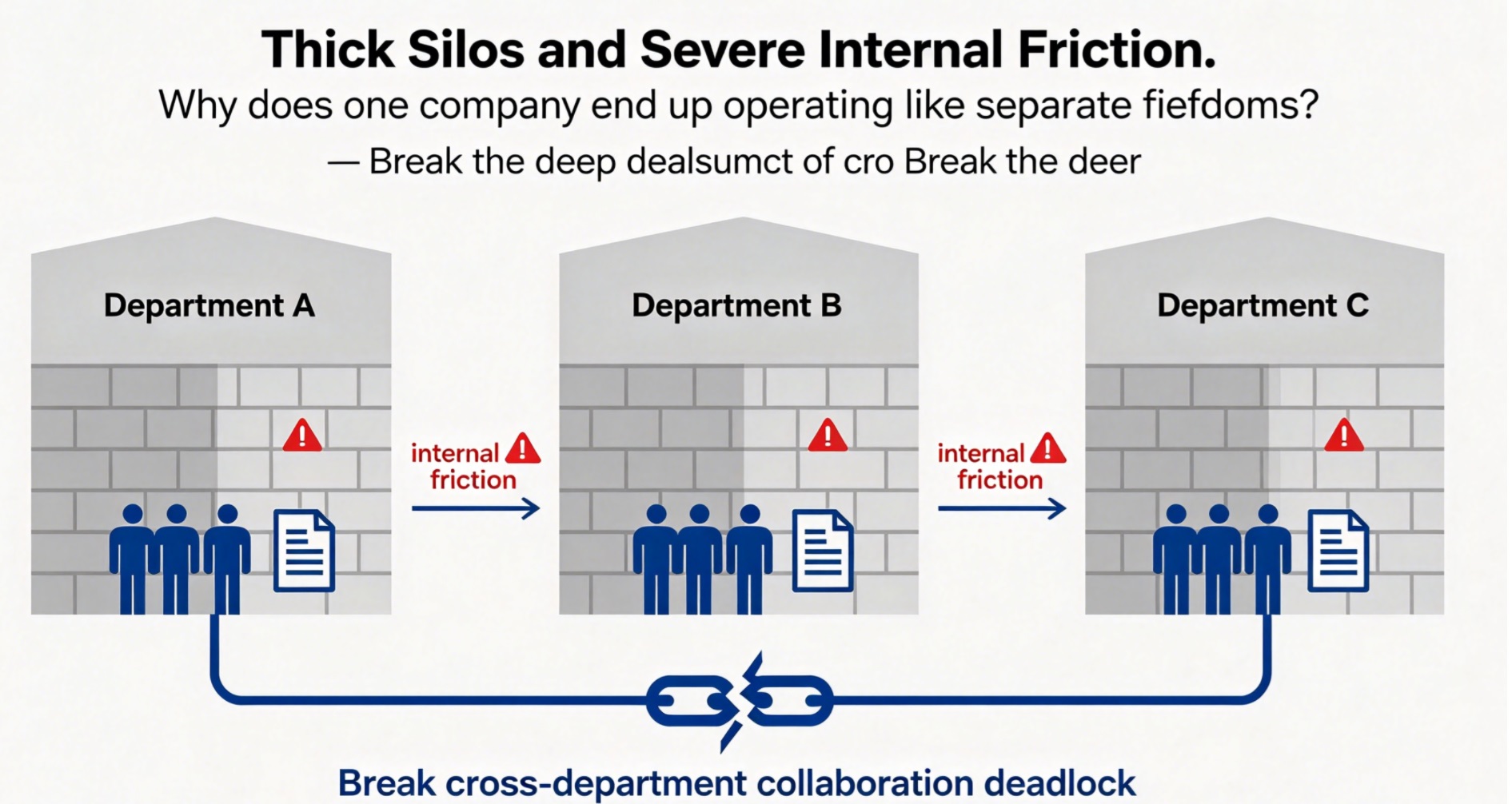
Thick Silos and Severe Internal Friction
—— Break the deep deadlock of cross-department collaboration
I. Do These Troubles Plague Your Organization?
“Sales blames the product team: ‘The products you develop are totally useless to customers!’ The product team blames technical staff: ‘Your solutions can’t deliver what we design!’ The technical team blames HR: ‘The talents you recruit are incompetent!’ Meetings turn into nothing but blame games. No problems get solved, yet plenty of time is wasted.”
“We acquired another company, expecting the synergy of one plus one being greater than two. Instead, the two teams are like oil and water that never mix. Long-serving staff feel their territory is invaded, while new members are left feeling excluded. Two years on, internal friction still persists.”
“Customers complain: ‘Your company’s services are so chaotic.’ When we raise the same issue to sales, customer service and technical teams, we get different answers every time. They ask: Who exactly is in charge here?”
If you recognize these scenarios, your organization is facing a covert yet devastating problem: department silos are eroding your growth profits.
II. Seven Manifestations of Department Silos — How Many Affect You?
1. Sales & Product Teams: What I Need You Don’t Have; What You Offer I Don’t Want
Typical scenario: Sales requests: "Customers demand Feature A!" The product team responds: "Feature A is not aligned with our product roadmap."
Result: Sales make commitments to close deals, while the product team delivers work with resentment. Customer experience is severely compromised.
Cost: Customer churn and broken trust.
2. Product & Technical Teams: What You Design Cannot Be Built; What I Build Is Not What You Want
Typical scenario: The product team says: "This feature is simple and can be finished in three days." Technical staff reply: "You know nothing. The underlying architecture cannot support it; it will take at least three months."
Result: The product team doubts the technical team’s reliability, while technicians think product staff lack professional knowledge.
Cost: Delayed delivery and fractured teamwork.
3. Marketing & Sales Teams: You Make Promises, and I Have to Clean Up the Mess
Typical scenario: Marketing states: "We have promised customers this service." Sales complains: "Why should I fulfill your overstated commitments?"
Result: Marketing accuses sales of poor performance, while sales blames marketing for making unrealistic promises.
Cost: Damaged brand reputation and declining business results.
4. Business Departments & HR: You Don’t Understand Our Work; You Don’t Understand People
Typical scenario: Business teams urge: "We urgently need talents!" HR replies: "We do recruit new hires, yet you fail to retain them."
Result: Business teams criticize HR for poor recruitment, while HR believes business leaders lack people management skills.
Cost: High talent turnover and unstable teams.
5. Headquarters & Regional Branches: You Live in the Cloud, While We Stand on the Ground
Typical scenario: Headquarters mandates: "The new strategy must be fully implemented!" Regional teams argue: "You have no insight into local markets, and we have our own operational approaches."
Result: Headquarters initiatives stall, and regional teams refuse to execute.
Cost: Strategies become empty plans, and execution breaks down.
6. Acquirer & Acquired Teams: You Are Outsiders, We Are Insiders
Typical scenario: The acquired party claims: "You do not understand our corporate culture." The acquiring party insists: "You must comply with our management system."
Result: Cultural clashes, broken trust and zero synergy.
Cost: Failed mergers and wasted investment.
7. Senior & New Team Members: You Don’t Know Our History; You Fail to See the Future
Typical scenario: Long-serving employees say: "We have always worked this way and achieved great results. Why change?" New employees respond: "Times have changed, and you are falling behind."
Result: Confrontation between senior and new staff and worsening internal friction.
Cost: Stagnant innovation and talent loss.
III. Unspoken Woes of Business Leaders
Pain Point 1: Stubborn Barriers Blocking Cross-Department Collaboration
"I emphasize collaboration and teamwork in every meeting, yet each department still only looks after its own interests. I have no idea how to break down these invisible silos, nor how to shift teams from working for their own departments to working for the whole company."
Pain Point 2: Unquantifiable Losses from Internal Friction
"I did the math: 30% of senior management meeting time is spent mediating inter-departmental conflicts, and another 50% is devoted to putting out fires. If we redirected this time to core business, we could earn at least an extra 100 million yuan."
Pain Point 3: Persistent Customer Complaints
"Most customer complaints are about inconsistent internal responses. Sales promise one thing, the delivery team provides another, and after-sales service offers a third. Customers keep asking who holds the final say."
Pain Point 4: Missed New Business Opportunities
"We spotted a promising new market, yet departments cannot work together. Sales say the product is uncompetitive, the product team blames technical limitations, and technical teams cite resource shortages. Great opportunities slip through our fingers."
IV. Why Conventional Solutions Never Work
|
Conventional Approaches |
Ineffective Performance |
Root Causes |
|
Repeatedly emphasize collaboration in meetings |
People shout slogans during meetings but revert to old habits afterwards. |
Collaboration is treated as a mandatory rule rather than a genuine willingness. Teams know they should cooperate, but not how or why. |
|
Adjust KPIs and OKRs |
Teams cooperate merely to hit targets and split up once goals are achieved. |
Collaboration becomes a temporary task instead of an embedded culture. |
|
Organize team-building activities |
Everyone enjoys the activities, yet nothing changes back at work. |
Temporary rapport fades quickly amid daily work. True collaboration is forged through tackling business challenges together, not leisure activities. |
|
Deliver communication skills training |
Employees learn skills but fail to apply them. |
The core problem lies in conflicting interests and lack of trust, not poor communication skills. Even top skills mean nothing without mutual trust. |
|
Launch cross-department job rotation |
Staff rotate roles but still operate in silos. |
Job rotation only solves information gaps, rather than conflicts of interest and cultural divides. |
|
Hire consultants to optimize workflows |
Well-designed processes are drafted but never implemented. |
External processes cannot take root in the organization. No process can work without internal team alignment. |
V. How Our Integration & Upgrade · Change Catalysis Drives Effective Results
We deliver far more than ordinary training — a complete collaboration system covering mindset alignment, mechanism design and cultural reshaping.
Step 1: Align Mindsets — Shift from Departmental Interests to Shared Goals
What we do
We host the CQ Business Breakthrough Workshop, guiding core teams to shift focus from individual KPIs to company-wide strategies.
We adopt the Co-Creation Vision Canvas to help every department clearly recognize its connection to corporate strategy and interdependence with other teams.
Why it works
Genuine collaboration comes from consensus, not orders. When departments participate in strategy co-creation, they evolve from passive implementers to active owners, working for the collective rather than individual teams.
Step 2: Design Mechanisms — Shift from Siloed Work to Collaborative Operations
What we do
We set up cross-department task forces, assembling backbones from different departments as elite teams to solve specific business difficulties.
We design a benefit-sharing mechanism, turning collaboration from self-sacrifice into a win-win choice. All contributors share rewards once a project succeeds.
Why it works
Reliable collaboration depends on sound mechanisms, not personal awareness. When collaboration brings greater benefits than confrontation, teams will naturally choose to cooperate.
Step 3: Build Capabilities — Shift from Blaming Each Other to Mutual Trust
What we do
Through the CQ Business Simulation Boardgame, teams experience the losses caused by department silos and the benefits of collaboration in simulated business scenarios.
We equip managers with core capabilities including cross-department communication, conflict resolution and interest balancing, turning collaborative slogans into actionable practices.
Why it works
Trust is built through joint practice, not empty words. When teams tackle challenges and solve problems together in simulations, mutual trust takes root naturally.
Step 4: Reshape Culture — Shift from Isolated Departmental Cultures to Unified Organizational Culture
What we do
We help enterprises establish a CEO Change Command Center, ensuring top leadership continuously empowers collaboration and removes obstacles.
We launch regular review and recognition mechanisms to highlight, acknowledge and promote collaborative behavior, making it the organization’s default working mode.
Why it works
A strong collaborative culture cannot be built via one-off projects, but sustained by complete systems. With long-term reinforcing mechanisms, collaboration will become normal practice rather than an exception.
VI. Proven Changes and Tangible Results
|
Client |
Core Challenges |
Our Solutions |
Achievements |
|
Leading Enterprise after Merger |
Integration of five subsidiaries, severe cultural conflicts and internal friction |
Integration & Upgrade · Change Catalysis |
67% business growth within 18 months; revenue exceeded 10 billion RMB. The fragmented groups evolved into a united team. |
|
European Multinational Industrial Group |
Cultural conflicts and broken trust between new and legacy teams |
Integrated System of Strategy, Culture & Capability |
Achieved twice the targeted growth in 9 months; built an internal talent development center. |
|
High-tech Enterprise |
Thick department silos and severe internal friction |
CQ Leadership Program |
70% business growth in 9 months; customer satisfaction rose by 30%. |
|
Large Home Furnishing Chain Store |
Conflicts between online and offline teams and siloed operations |
CQ Breakthrough · Value Restructuring |
Its transformation story was featured in a national documentary, setting a benchmark for the industry. |
VII. Client Testimonials
"ICT helped us complete the crucial transformation from scattered groups to a united team. Doubled growth is a remarkable result, but building a sustainable, high-performance organization is our most valuable asset."
— President of Greater China, European Multinational Industrial Group
"While everyone was arguing over who was right or wrong, ICT guided us to reflect on a more fundamental question: What is our shared goal? The answer turned mutual blame into mutual trust within our team."
— Senior Management Team, Merger Project of a Leading Enterprise
VIII. Your Next Move
If your organization is troubled by department silos and trapped in endless internal friction, we invite you to join an in-depth organizational diagnosis session.
During this 60-minute closed-door meeting, we will:
1. Pinpoint the root causes of department silos (mindset issues, mechanism flaws or cultural divides)
2. Discuss customized solutions for breaking collaboration deadlocks based on the Integration & Upgrade · Change Catalysis system
3. Deliver a detailed Roadmap for Cross-Department Collaboration and Organizational Integration