Solve the Deep Dilemma of Unsustainable Transformation
Source: ICT Singapore Official Website | Author: Catherine Wong | Date: August 18, 2024
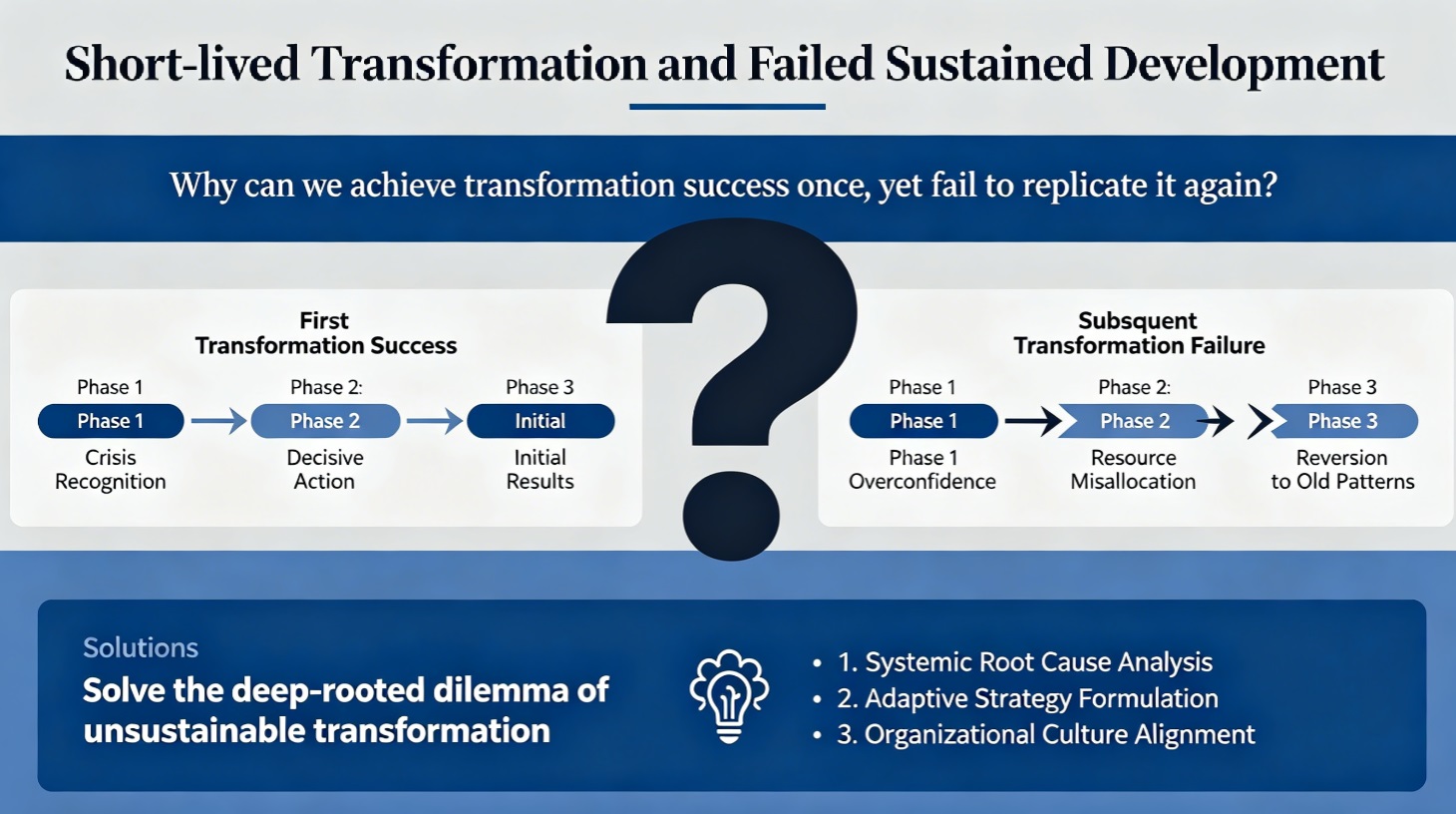
Short-lived Transformation and Failed Sustained Development
"Why can we achieve transformation success once, yet fail to replicate it again?" —— Solve the deep-rooted dilemma of unsustainable transformation
I. Do These Dilemmas Happen to You?
"We launched a transformation project last year which delivered remarkable results, driving a 30% performance growth. The leadership was delighted and decided to continue the initiative this year. However, with the same methods, team and project arrangements, we saw mediocre outcomes this time. When I asked the team for reasons, they said, 'We just got lucky last year, and the luck ran out this time.'"
"Teams always slip back to old routines once a transformation project concludes. Everyone is passionate during training yet reverts to old ways back at work. New approaches are abandoned within weeks, overwhelmed by long-standing habits. I struggle to make changes stick permanently."
"We have carried out various transformations, including process optimization, digital upgrading and organizational restructuring. Each initiative brought temporary progress, but none could be sustained. The team is worn out, and I am on the verge of giving up. I cannot help but wonder: Is our organization truly capable of continuous evolution?"
If you can relate to these scenarios, your organization is facing a hidden yet critical challenge: Transformation is merely a temporary achievement, rather than a lasting organizational capability.
II. Four Typical Patterns of Unsustainable Transformation — Which One Affects You?
Pattern 1: Result Fade-Out — Achievements Vanish Once Projects End
Symptoms: Performance rises steadily during transformation projects but drops sharply afterwards. The team believes the results belong to the project team alone, not the whole organization.
Root Cause: Transformation is treated as a temporary project instead of an organizational priority. Outcomes are never fully internalized and disappear once the project wraps up.
Pattern 2: Behavioral Regression — Old Habits Resume After Training
Symptoms: Employees are highly motivated during training, yet everything returns to normal at work. New working methods are quickly replaced by outdated routines within a few weeks.
Root Cause: Behavioral changes are only short-term. Without continuous reinforcement mechanisms, new habits can never take root.
Pattern 3: Capability Disconnection — Competencies Fade Without External Experts
Symptoms: The team performs excellently when supported by consulting experts, but reverts to old practices once external support is withdrawn.
Root Cause: Capabilities rely on external resources rather than internal strength. Lacking internal talent development mechanisms, the organization becomes dependent on external assistance.
Pattern 4: Cultural Stagnation — Corporate Culture Remains Unchanged
Symptoms: Transformation projects are carried out vigorously, while the organizational culture stays the same. New rules, processes and methods are all neutralized by ingrained old culture.
Root Cause: Corporate culture is the soil, and transformation is the seed. The seed can never take root and grow if the soil remains unchanged.
III. Unspoken Frustrations of Business Leaders
Pain Point 1: Non-replicable Results — "Why can’t we replicate past success?"
"We thought we had found the winning formula after last year’s successful project. Yet applying the same approaches this year brought no satisfactory results. I cannot identify the real problem — is it flawed methods or an incapable team?"
Pain Point 2: Difficulty in Standardizing Behaviors — "How to prevent regression after training?"
"The team is excited right after training but falls back into old routines soon afterwards. New methods never last long against old habits. I have no idea how to make changes endure."
Pain Point 3: Inseparable External Support — "Capabilities disappear once experts leave"
"Our team works efficiently with consultants on-site yet struggles to maintain standards once external experts depart. I want to know how to fully internalize professional capabilities."
Pain Point 4: Stubborn Corporate Culture — "Transformation delivers no cultural progress"
"We have implemented numerous transformation initiatives, but the organizational culture never evolves. New systems and workflows are all offset by traditional mindsets. I do not know how to reshape the cultural foundation."
IV. Why Conventional Approaches Fail to Solve the Problem
|
Conventional Approaches |
Ineffective Outcomes |
Root Causes |
|
Hire consulting firms to run projects |
Achievements disappear once projects end. |
Capabilities are externally sourced instead of internally cultivated. Without internal talent incubation mechanisms, the organization will always rely on external support. |
|
Organize training sessions |
Behaviors revert to old norms after training. |
Behavioral changes are only temporary. New habits cannot be established without continuous reinforcement. |
|
Formulate rules and optimize processes |
Rules and processes exist on paper but are never followed. |
Systems are externally imposed instead of widely recognized. Even the best rules become meaningless without team consensus. |
|
Adjust performance appraisal mechanisms |
Employees pursue transformation merely to meet assessment targets. |
Transformation turns into a mandatory task rather than a natural habit. Teams execute passively instead of embracing changes voluntarily. |
|
Introduce new tools |
Purchased tools are left unused by employees. |
Tools are externally introduced instead of well-adapted. Without proper mindset preparation and matching capabilities, tools become mere decorations. |
V. How Our Growth Engine System Delivers Sustainable Results
We provide more than regular training — a complete transformation system that drives development from external input, internal capability building to continuous organizational evolution.
Step 1: Internalize Capabilities — Shift from External Experts to In-house Change Catalysts
What we do
We launch an internal certification program for Change Catalysts, selecting and training a stable in-house expert team from core employees.
We adopt experience extraction and curriculum development methodologies to convert transformation theories and methods into replicable and inheritable internal training courses.
Why it works
Genuine transformation capabilities are cultivated internally, not purchased from outside. With a dedicated team of in-house change catalysts, transformation evolves from one-off projects into enduring organizational capabilities.
Step 2: Standardize Behaviors — Shift from Temporary Changes to Daily Routines
What we do
We establish a mechanism for behavior recording, review and iteration, ensuring new working practices are noticed, recognized and reinforced in daily operations.
Regular review and reward systems are put in place to make transformative behaviors the default working mode across the organization.
Why it works
Sustained behavioral change relies on standardized systems rather than personal willpower. When new practices are integrated into daily workflows, changes will no longer be seen as a burden but become natural habits.
Step 3: Reshape Culture — Shift from Static Cultural Soil to Evolving Ecosystem
What we do
We help enterprises set up a CEO Change Command Center and a Transformation Committee, ensuring top leadership continuously empowers initiatives and removes obstacles for transformation.
We build a mechanism for sharing transformation stories, turning successful cases into organizational legends and letting the new transformation culture spread and take root naturally.
Why it works
Corporate culture evolves gradually rather than being revised artificially. When the seeds of transformation are sown, nurtured and shared widely, the organizational culture will upgrade spontaneously.
Step 4: Solidify Systems — Shift from One-time Success to Sustained Development
What we do
We establish a Growth Indicator & Flywheel Operation System, converting transformation achievements into trackable and optimizable growth momentum.
By leveraging the in-house Growth Catalyst mechanism, we embed transformation capabilities into the organizational DNA and enable constant self-improvement.
Why it works
A transformative organization thrives on mature systems rather than individual projects. With sustainable iteration mechanisms, transformation will become a normal part of development instead of a painful chore.
VI. Tangible Changes and Proven Results
|
Client |
Core Challenges |
Our Solutions |
Achievements |
|
State-owned Coal & Energy Enterprise |
Transformation requires repeated promotion and cannot be sustained |
CQ Empowerment · Talent Ecosystem System |
Regular retraining every 2 to 3 years. Transformation capabilities have become standard organizational strengths. The enterprise was awarded the title of Industrial Leader and Outstanding Contributor to Steady Growth. |
|
Leading Logistics Enterprise |
Training outcomes fail to last |
CGEE Growth Engine |
Training effectiveness increased by 190%. The training department evolved from a cost center into a growth driver, with results continuously amplified. |
|
E-commerce Platform |
Difficulty replicating core capabilities during regional expansion |
TTT Growth Engine |
Became a powerful tool to replicate successful practices rapidly across Southeast Asian markets. Transformation capabilities are fully transferable and replicable. |
|
Large Corporation |
Over-reliance on external experts and difficulty internalizing capabilities |
Internal Talent Engine |
67% business growth within 18 months. A self-driven internal leadership development and inheritance mechanism was established. |
VII. Client Testimonials
"ICT’s TTT Growth Engine has turned the scattered expertise of business specialists into highly replicable organizational wisdom. It has built a solid talent and knowledge foundation for the long-term sustainable development of our platform."
— Director of Talent Development, Cross-border E-commerce Group
"I once believed success came from hard work, but now I understand that real achievement depends on robust systems. ICT has helped me turn personal experience into a unified operational roadmap. Today, our company maintains steady profitability, and we run the business with ease and a strong sense of fulfillment."
— General Manager, Large Retail Chain Group
"Working with ICT has made us realize that real growth relies on people rather than resources. Retraining every two to three years has become a regular rhythm for our organizational evolution. Behind our continuous breakthroughs stands a dedicated learning-oriented team."
— Leadership Team, State-owned Coal & Energy Enterprise
VIII. Your Next Move
If your transformation initiatives are short-lived and your organization lacks the capacity for continuous evolution, we invite you to join an in-depth transformation diagnosis session.
During this 60-minute closed-door meeting, we will:
1. Accurately identify the root causes of unsustainable transformation (uninternalized results, regressive behaviors, disconnected capabilities or stagnant culture)
2. Discuss customized paths for continuous organizational evolution based on the Growth Engine System
3. Deliver a detailed Roadmap for Sustained Organizational Development