
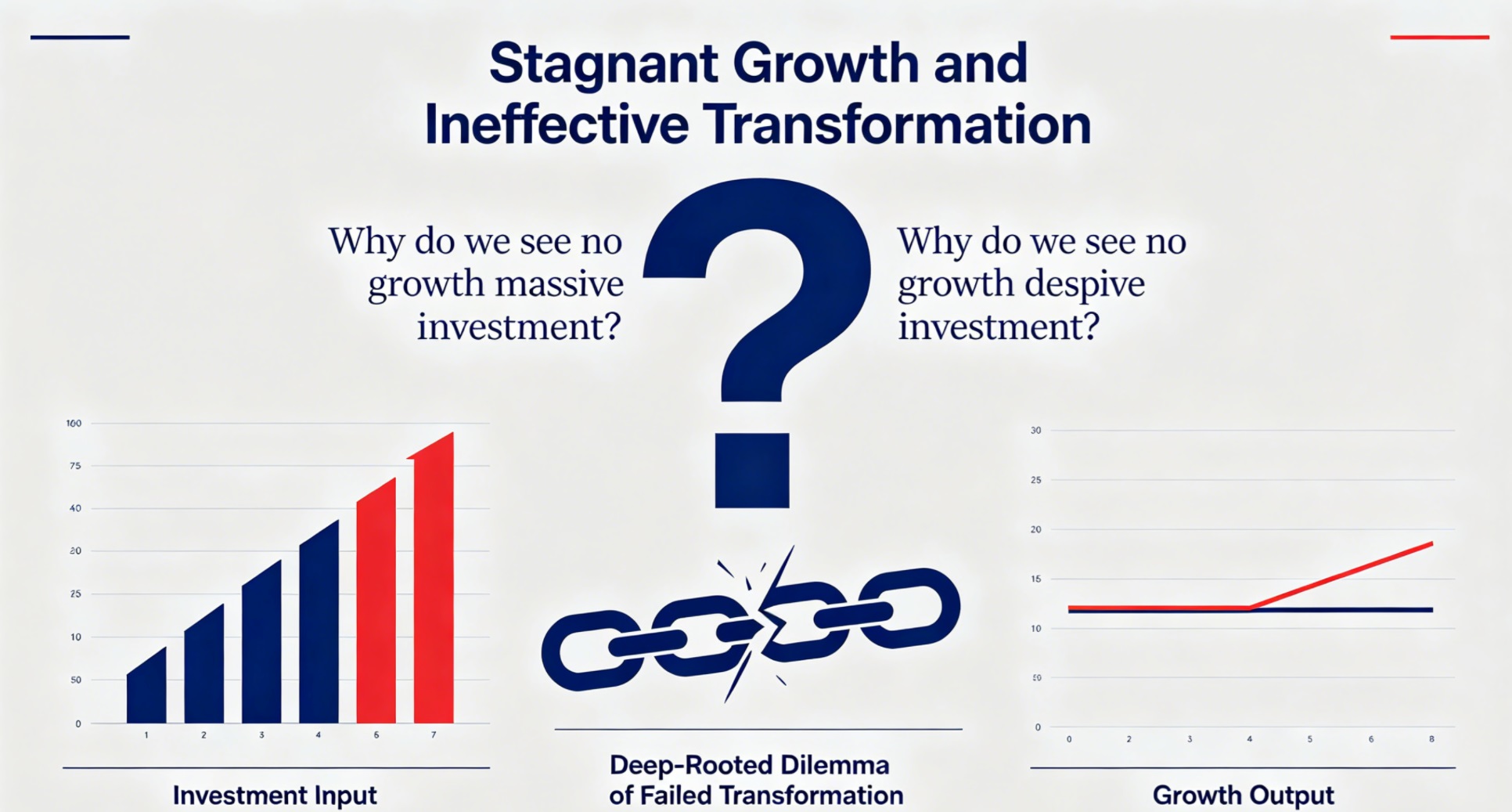
Solve the Deep Dilemma of Failed Transformation
Source: Official Website | Author: Catherine Wong | Date: March 15, 2024
Stagnant Growth and Ineffective Transformation
"Why do we see no growth despite massive investment?" —— Solve the deep-rooted dilemma of failed transformation
I. Do These Troubles Plague Your Organization?
"We have pushed forward transformation for three years and poured in hundreds of millions of funds. We hired consulting firms, deployed new systems and delivered staff training. Yet our revenue and profits remain unchanged. When the board asks where all the money went, I have no answer."
"At the end of every year, we repeat the same routines: reviewing past performance, making plans and setting new targets. Year after year, targets stay the same and results never improve. The team is worn out, and I am on the verge of giving up."
"While competitors forge ahead, we stand still. I know transformation is a must, but I have no idea how to carry it out. Worse still, the team begins to doubt: Can we really make a difference?"
If you recognize these scenarios, your organization is facing a covert yet severe challenge: rising investment, fading confidence and disappearing growth.
II. Four Typical Patterns of Failed Transformation — Which One Applies to You?
Pattern 1: Ineffective Due to Blind Investment — Money Spent with No Tangible Results
Symptoms: Substantial costs are incurred on consulting, training, system deployment and marketing, while key performance indicators stay flat. The team questions whether such investments are worthwhile.
Root Cause: Resources are scattered rather than focused. Diluted input fails to generate combined momentum.
Pattern 2: Ineffective Due to Lack of Execution — Bold Slogans Without Action
Symptoms: Leaders stress that transformation is a matter of survival in every meeting, yet everyone falls back to old routines at work. The team claims they are working hard, but the results tell the truth.
Root Cause: Determination only lies with leaders, not the whole team. Transformation fails to take root across the organization, leading to compromised execution.
Pattern 3: Ineffective Due to Flawed Methodology — Well-designed Plans Hard to Implement
Symptoms: Consulting firms deliver elaborate transformation plans, but internal teams lack the capability to execute them. The plans end up gathering dust on bookshelves.
Root Cause: External plans cannot be integrated into the organization. Even the finest strategies are useless without team consensus and practical capabilities.
Pattern 4: Ineffective Due to Low Morale — Weary Teams Losing Motivation
Symptoms: After years of transformation with little progress, the team suffers from burnout. New initiatives are always met with a reluctant reaction of "Here we go again".
Root Cause: Team confidence is consumed over time rather than renewed. Without quick wins and clear milestones, people gradually lose drive.
III. Unspoken Frustrations of Business Leaders
Pain Point 1: Unclear Return on Investment — "Where Did the Money Go?"
"We spend tens of millions on transformation every year, yet we cannot calculate the ROI, identify effective initiatives or phase out inefficient projects. I have no answers for the board. This opaque situation keeps me awake at night."
Pain Point 2: Eroding Team Confidence — "Doubt Is Spreading"
"Three years of transformation have worn the team down. They keep asking me if we can truly change. To make matters worse, I am haunted by the same doubt."
Pain Point 3: Unrealistic Growth Targets — "Targets Never Met Year After Year"
"We go through reviews, planning and goal-setting every year-end, but nothing really changes. The team has become indifferent, and I am losing my motivation too."
Pain Point 4: Widening Gap with Competitors — "They Advance While We Stay Put"
"Competitors keep moving forward while we remain stuck. I know transformation is necessary, but I cannot find the right direction or pinpoint the real problems."
IV. Why Conventional Approaches Fail
|
Conventional Approaches |
Ineffective Performance |
Root Causes |
|
Hire consulting firms to design transformation plans |
Well-crafted plans are never put into practice. |
External plans cannot take root internally. No plan can work without team consensus and capabilities. |
|
Increase training investment |
Training is delivered but brings no real changes. |
Training is treated as a one-off activity instead of a systematic project. Without follow-up and implementation mechanisms, it is nothing but a temporary buzz. |
|
Expand marketing investment |
Performance rises temporarily then drops back. |
Growth relies on external stimuli rather than internal strength. Without solid value support, customers will leave eventually. |
|
Learn from benchmark enterprises |
Practices from leading companies cannot be applied locally. |
Successful experience belongs to others. Blind imitation leads to poor adaptation. |
|
Adjust KPIs and OKRs |
Transformation becomes a task to hit indicators, and staff work perfunctorily for scores. |
Transformation is viewed as a mandatory assignment instead of a shared aspiration. Teams execute passively rather than taking initiative. |
|
Increase R&D investment |
Heavy investment yields no outputs. |
Innovation cannot be achieved simply by pouring in funds. Without market insights and collaboration mechanisms, R&D becomes isolated trial and error. |
V. How Our CQ Breakthrough · Growth Engine Delivers Effective Results
We provide more than regular training — a complete transformation system covering diagnosis, solution design, implementation and system building.
Step 1: Accurate Diagnosis — Shift from Scattered Investment to Focused Input
What we do
We use the Transformation Profit & Loss Dashboard to assess the ROI of ongoing transformation initiatives and distinguish effective moves from ineffective ones.
Through growth diagnosis and blueprint design, we help enterprises identify the root causes of growth bottlenecks, clarify growth leverage points, and formulate focused strategic maps and implementation plans.
Why it works
Success lies in doing the right things, not everything. Focused investment prevents resource dilution and creates clear breakthrough points for growth.
Step 2: Reset Mindsets — Shift from Passive Execution to Active Accountability
What we do
We host the CQ Business Breakthrough Workshop. In simulated business scenarios, teams experience the risks of sticking to old models and the benefits of embracing change.
The CQ® Assessment helps every manager evaluate their status in transformation and find personal growth directions.
Why it works
Transformation should be the team’s aspiration, not just a leader’s order. When teams realize that refusing to change means being eliminated, they will embrace transformation voluntarily.
Step 3: Internalize Capabilities — Shift from External Plans to In-house Competencies
What we do
We launch an internal certification program for Growth & Change Catalysts, selecting and cultivating a stable in-house expert team from core employees.
The 90-Day Lightning Breakthrough Program enables teams to apply new methods to solve real business challenges and build capabilities through hands-on practice.
Why it works
Genuine transformation capabilities are nurtured internally, not purchased from outside. With in-house change catalysts, transformation evolves from a one-off project into sustained organizational strength.
Step 4: Solidify Systems — Shift from One-off Transformation to Continuous Evolution
What we do
We establish a Growth Indicator & Flywheel Operation System, define Key Growth Indicators (KGIs) and launch data dashboards to form a virtuous cycle of customer acquisition, retention and expansion.
Supported by the CEO Change Command Center and regular review mechanisms, transformation becomes a normal working rhythm and growth becomes an organizational habit.
Why it works
A transformative enterprise thrives on complete systems rather than individual projects. With sustainable iteration mechanisms, transformation will no longer feel painful but become a natural part of development.
VI. Tangible Changes and Proven Results
|
Client |
Core Challenges |
Our Solutions |
Achievements |
|
Leading Manufacturing Enterprise |
Failed transformation after merging five subsidiaries |
CQ Leadership · Integrated Upgrade |
67% business growth within 18 months; revenue exceeded 10 billion RMB |
|
High-tech Enterprise |
Transformation pains amid policy adjustments |
CQ Breakthrough System |
70% business growth in 9 months; customer satisfaction rose by 30% |
|
Healthcare Enterprise |
Sharp policy changes led to a drastic business decline |
CQ Breakthrough System |
All investment recovered within 20 days after training; won major bids and turned losses into profits |
VII. Client Testimonials
"In our toughest times, reshaping the team with Change Quotient is the most valuable investment. It fully reflects how our team shifted from waiting for help to taking charge of our own future."
— Chairman, Telecommunications Equipment Company
"ICT helped us complete the crucial transformation from scattered groups to a united team. Doubled growth is a remarkable result, but building a sustainable, high-performance organization is our most valuable asset."
— President of Greater China, European Multinational Industrial Group
VIII. Your Next Move
If your transformation is plagued by heavy investment and slow returns, and your team is losing confidence, we invite you to join an in-depth transformation diagnosis session.
During this 60-minute closed-door meeting, we will: