
Why Performance Surges One Year, Then Slumps the Next?
Source: Official Website | Author: Catherine Wong | Date: September 25, 2023
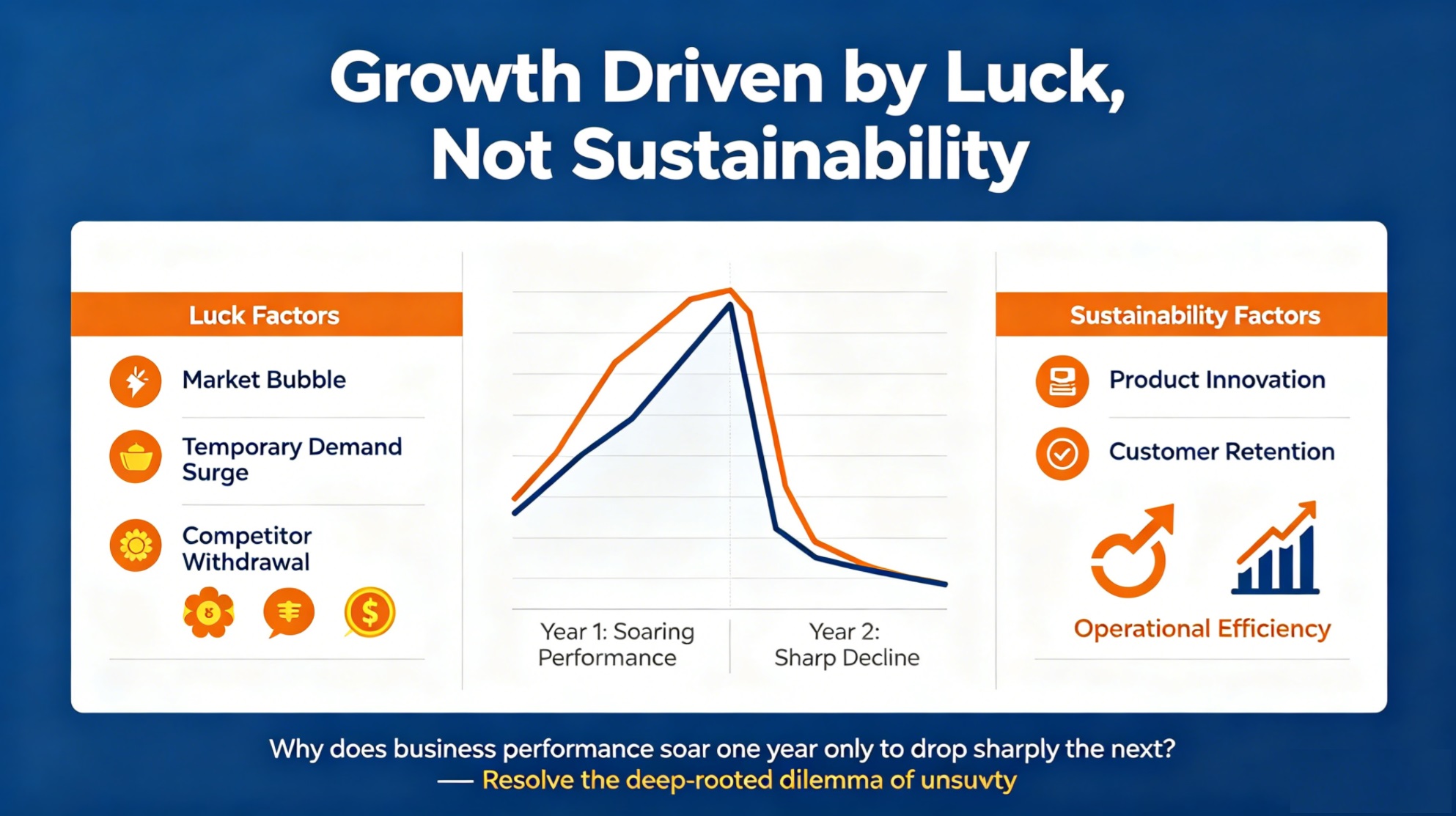
Growth Driven by Luck, Not Sustainability
"Why does business performance soar one year only to drop sharply the next?" —— Resolve the deep-rooted dilemma of unsustainable growth
I. Do These Plagues Trouble Your Organization?
"We achieved phenomenal results last year, which delighted the leadership. This year, with the same team, products and strategies, our performance has plunged dramatically. When I asked the team why, they said, 'We just got lucky and landed a major client last year.'"
"Every sales campaign brings a temporary spike in performance, yet figures drop as soon as promotions end. Customers come and go, and we fail to retain them. I have no idea how to maintain steady growth."
"I worry about next year’s growth targets every year-end. The winning tactics from last year cannot be replicated, and previous growth paths no longer work. I feel lost about where to seek new momentum."
If you recognize these scenarios, your organization is facing an insidious yet fatal problem: your growth relies on luck rather than solid capabilities.
II. Four Typical Patterns of Unsustainable Growth — Which One Fits Your Business?
Pattern 1: Hero-Dependent Growth — Performance Relies on Individuals Instead of Systems
Symptoms: Performance nosedives once top sales talents leave. Key client resources are controlled by a handful of people, leaving the company highly vulnerable to risks.
Root Cause: Growth is built on individual capabilities rather than organizational strength. Valuable experience resides with employees instead of standardized systems.
Pattern 2: Short-Term Incentives — Growth Fueled by Temporary Boosts Instead of Core Competencies
Symptoms: Sales jump during promotions but decline immediately afterwards. Customers are attracted by discounts but never stay loyal.
Root Cause: Growth is driven by external stimuli rather than internal strengths. Customers come for low prices, not genuine value.
Pattern 3: Ambiguous Investment — Funds Are Spent with No Clear Outcomes
Symptoms: The company invests tens of millions annually in marketing, training and R&D, yet no one can clarify the return on investment (ROI), identify high-performing channels or pinpoint which initiatives actually drive growth.
Root Cause: The whole growth process is a black box instead of a transparent system. Investments and outcomes cannot be measured or assessed scientifically.
Pattern 4: Path Dependence — Past Successes Cannot Be Replicated
Symptoms: Proven strategies from the previous year become ineffective. Both managers and teams feel anxious but struggle to explore new directions.
Root Cause: Growth happens by chance rather than design. There is no replicable or predictable growth model.
III. Unspoken Woes of Business Leaders
Pain Point 1: Volatile Performance — Uncertainty About Future Growth
"We enjoyed a sharp rise in performance last year, followed by a steep decline this year. The team attributed it to good fortune, leaving me anxious about what the future holds. This roller-coaster trend keeps me up at night."
Pain Point 2: Over-Reliance on Talent — Collapse After Core Employees Depart
"Our biggest threat is not competitors, but the resignation of our star salespeople. When they leave, key clients and revenue go with them. I struggle to convert individual expertise into organizational capabilities."
Pain Point 3: Unclear ROI — No Clarity on Capital Allocation
"We pour tens of millions into marketing, training and R&D every year, yet we cannot calculate ROI, evaluate channel efficiency or track growth drivers. I have no answers when senior leaders raise questions."
Pain Point 4: Growth Bottlenecks — No New Growth Drivers in Sight
"We have made various attempts but only achieved isolated breakthroughs instead of comprehensive growth. I know we need to build a powerful growth engine, yet I cannot figure out where to start."
IV. Why Conventional Solutions Fail
|
Conventional Approaches |
Ineffective Results |
Root Causes |
|
Recruit talents with high salaries |
New hires fail to deliver results, or performance drops once they resign. |
Growth relies on individuals rather than systems. Without standardized mechanisms, talents will always be transient. |
|
Scale up promotional activities |
Performance surges temporarily then falls back. Customers cannot be retained long-term. |
Growth is driven by external incentives rather than internal value. Customers are drawn by discounts instead of brand value. |
|
Hire consulting firms to design growth plans |
Elaborate reports are produced but never implemented. |
External plans cannot take root in the organization. Even the best strategies are useless without team alignment and practical capabilities. |
|
Increase investment in training |
Training sessions are held, yet no real changes occur. |
Training is treated as a one-off activity instead of a systematic project. Without continuous follow-up and implementation mechanisms, training yields no lasting effects. |
|
Expand R&D spending |
Heavy investment generates no tangible outputs. |
Innovation cannot be achieved merely by injecting funds. Without market insights and cross-team collaboration, R&D becomes isolated trial and error. |
V. How Our Growth Engine System Delivers Sustainable Results
We offer far more than regular training — a complete growth system that upgrades capabilities from individual performance to organizational and systematic strength.
Step 1: Empower Talent — Shift from Individual Heroes to Organizational Capabilities
What we do
We launch an internal certification program for Enterprise Growth Catalysts, selecting and cultivating a stable in-house expert team from core employees.
We adopt experience extraction and curriculum development methodologies to convert the tacit expertise of top salespeople, technical specialists and senior managers into explicit, replicable and inheritable knowledge.
Why it works
Long-term growth depends on robust systems, not outstanding individuals. When valuable experience is documented, replicated and passed down, the organization gains solid risk resistance.
Step 2: Break Through Business Bottlenecks — Shift from Short-Term Stimuli to Organic Growth
What we do
Leverage the CQ® Innovation Breakthrough System to help teams move beyond price competition and build irreplicable differentiated advantages.
Apply the Dynamic Customer Demand Map to design compelling value propositions that make customers choose your brand unconditionally, based on genuine customer needs.
Why it works
Customers stay loyal for value, not low prices. When your organization delivers irreplaceable value, growth will no longer rely on temporary promotions.
Step 3: Build Growth Engines — Shift from Ambiguous Investment to Clear ROI
What we do
Establish a Growth Indicator & Flywheel Operation System, define Key Growth Indicators (KGIs) and launch data dashboards to create a virtuous cycle of customer acquisition, retention and expansion.
Deploy a Change & Benefit Dashboard to track real-time input and output of growth projects, visualize hidden costs and calculate accurate ROI.
Why it works
Unmeasurable growth is always driven by luck. When every investment can be tracked and evaluated, growth evolves from a black box into a transparent, controllable system.
Step 4: Solidify Systems — Shift from Occasional Success to Sustained Excellence
What we do
Build a Growth Flywheel Operation Mechanism, turning core business processes (customer acquisition, conversion, retention and repeat purchases) into a repeatable and optimizable closed-loop system.
Embed growth capabilities into the organizational DNA via the Growth Catalyst mechanism, enabling continuous self-improvement.
Why it works
A growth-oriented enterprise thrives on mature systems rather than occasional successful projects. With sustainable iteration mechanisms, steady growth becomes inevitable rather than accidental.
VI. Measurable Changes & Proven Achievements
|
Client |
Core Challenges |
Our Solutions |
Outcomes |
|
Leading Logistics Enterprise |
Large training investment with unclear ROI |
CGEE Growth Engine |
Training effectiveness increased by 190%; the training department transformed from a cost center into a growth driver |
|
Large Corporation |
Growth dependent on individuals rather than systems |
Internal Talent Engine |
67% business growth within 18 months, hitting key development milestones |
|
E-commerce Platform |
Difficulty replicating capabilities during regional expansion |
TTT Growth Engine |
Became a core tool to replicate successful business models rapidly across Southeast Asian markets |
|
Consulting Firm |
Luck-based unsustainable growth |
CQ Breakthrough & Innovation Transformation |
400% business growth within 3 years, with a fully established replicable growth model |
VII. Client Testimonials
"ICT’s TTT 4.0 Growth Engine has converted the scattered expertise of business professionals into replicable organizational wisdom. It has built a solid talent and knowledge foundation for the long-term sustainable development of our cross-border e-commerce group."
— Director of Talent Development, Cross-border E-commerce Group
"I once believed success came from sheer hard work, but now I realize that true excellence relies on sound systems. ICT has helped us turn personal experience into a unified operational roadmap. Today, our company maintains steady profitability, and we run the business with both ease and a strong sense of accomplishment."
— General Manager, Large Retail Chain Group
VIII. Your Next Move
If your business growth is still driven by luck and your performance keeps fluctuating like a roller coaster, we invite you to join an in-depth growth diagnosis session.
During this 60-minute closed-door meeting, we will: