
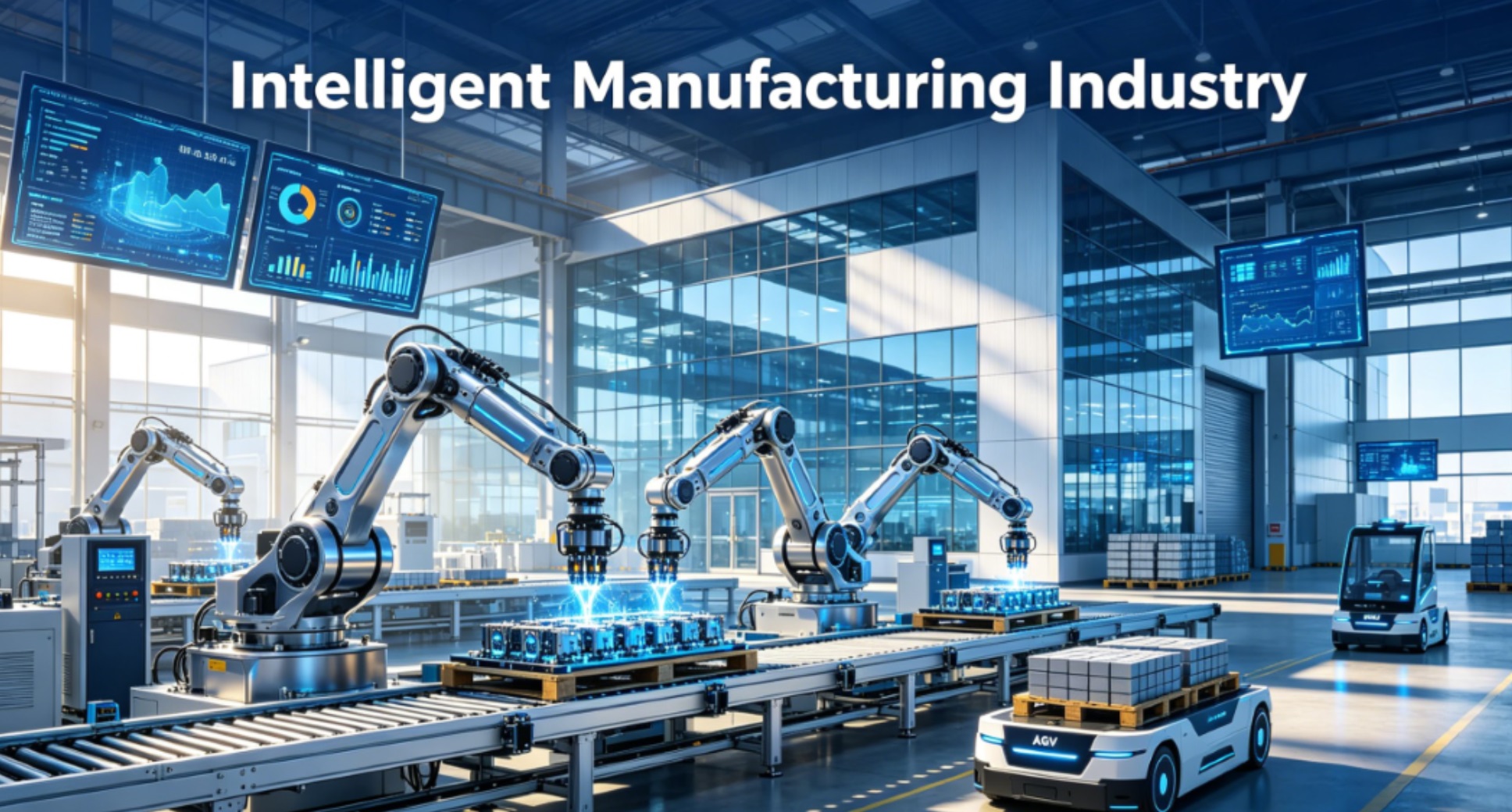
Intelligent Manufacturing Industry Insights 2026–2030: From Digital-Intelligent Enablement to Value Reinvention
Guidelines for the Application of the Corporate Growth Engine System Solution
I. Industry Landscape: AI Sparks Transformation, China Leads Globally
The year 2026 marks a critical watershed for intelligent manufacturing. Artificial intelligence is evolving from a "technical variable" into a "powerful growth driver" for the manufacturing sector, profoundly reshaping the global industrial landscape.
1. Global Landscape: China Leads, Europe & US Chase, Emerging Markets Rise
- China emerges as a global benchmark for intelligent manufacturing: To date, China has built over 35,000 basic-level, 8,200 advanced-level, 500 excellence-level, and 15 pilot-level smart factories. Among the world’s 224 "Lighthouse Factories," China accounts for 101, or 45%. In digital twin adoption, 84% of Chinese enterprises deploy the technology in logistics and other workflows, far exceeding Germany’s 42%.
- Global digital divide widens: MHP Consulting’s 2026 Industry 4.0 Barometer reports the global industrial digitalization average at 66%. China leads with 72%, ahead of the US (69%), India (68%), and Mexico (67%), while the UK (62%) and the DACH region (57%) lag significantly.
- AI boom fuels computing demand: The UN projects the global AI market will reach $4.8 trillion by 2033. Over 30 million AI agents already collaborate across industries, penetrating core production workflows.
2. China’s Position: "AI+" Elevated to National Strategy
- 15th Five-Year Plan sets clear direction: China explicitly mandates the full implementation of the "AI+" initiative to seize the high ground in industrial AI application and empower all sectors. By the end of the 15th Five-Year Plan (2030), AI-related industries are projected to exceed RMB 10 trillion in scale.
- Policy shifts from "digital enablement" to "digital-intelligent enablement": The 2024 focus on "digital enablement" has evolved by 2025 into "digital-intelligent enablement"—a shift beyond technical upgrades to emphasize data value extraction, intelligent application, and business model reinvention.
II. Core Challenges: From Machine Upgrades to Talent Upgrades
1. Weak Data Foundations & Severe Silos
- Data silos persist across enterprises and industries, lacking national industrial data standards and sharing mechanisms. Intelligent manufacturers struggle to share process data, leaving high-value data fragmented and unavailable for large-scale, standardized model training.
- Heterogeneous legacy systems and fragmented data architectures create technical barriers for 40%–47% of enterprises.
2. "Fear to Pilot, Reluctance to Adopt" in Domestic Substitution
- High barriers hinder the first deployment and initial batch application of homegrown innovations. Enterprises face significant production disruption risks when adopting domestic industrial software and high-end equipment, with limited risk-sharing mechanisms.
3. Structural Talent Shortage — The Critical Bottleneck
- "Machines upgrade; people must upgrade too," stressed Dong Mingzhu, Chairperson of Gree Electric. While automation advances rapidly, interdisciplinary technical talent lags, limiting full production line efficiency.
- Dr. Martin Brudermüller, Chairman of BASF’s Executive Board, emphasized: Even with cutting-edge technology, talent determines success. The industry needs professionals versed in process, data, and AI.
- Nobel laureate Dr. Peter Howitt called for education reform to equip youth with AI literacy while preserving independent thinking.
4. Lagging Alignment with Global Standards
- In carbon accounting and green energy certification, domestic standards lack full international recognition, creating hidden technical barriers for Chinese enterprises in global markets.
III. Future Trends: Infrastructure, Industrial Intelligence & Green Integration
1. Trend 1: Digital-Intelligent Infrastructure as the New Foundation
- Accelerate the buildout of multi-tiered computing infrastructure and advance new infrastructure projects such as computing-power-grid coordination. Develop open digital-intelligent public service platforms for SMEs, delivering lightweight, agile, accurate, and affordable intelligent tools.
2. Trend 2: Full Industrial Connectivity & the "Industrial Brain"
- Deep integration of "AI + Industrial Internet" drives systemic restructuring of organizations and talent. This is where the Growth Engine training and micro-consulting solution delivers maximum value.
IV. Action Roadmap: Drive Sustainable and Steady Corporate Growth
1. External Breakthrough via Change Quotient: Create New Value
Challenge: Severe product homogenization, price wars, and failure to address deep customer needs.
Solutions from Growth Engine:
- Solution-Based Marketing Workshop: Train frontline teams to shift from selling equipment to delivering smart factory solutions. Drawing on Sany Heavy Industry’s "globalization, digital-intelligence, electrification" strategy, help clients identify productivity and energy pain points, and deliver customized AI+manufacturing services.
- Enhance Change Quotient: Navigate carbon barriers and data compliance in global expansion by fostering a "community of interests" mindset with overseas clients and local partners. Leverage blockchain and IoT to build national "digital product passports," strengthen carbon accounting capabilities, and secure "green passes" for global trade.
2. Internal Empowerment: Cultivate Talents as Corporate Growth Catalysts
Challenge: Technical teams lack business acumen, business teams lack AI literacy, and cross-departmental collaboration falters.
Solutions from Growth Engine:
- Growth Catalyst Training Camp: Select business and technical leaders to train interdisciplinary internal catalysts proficient in process, data, and AI.
(a) Knowledge empowerment: Cover cutting-edge topics including Industrial Internet, digital twins, software-defined manufacturing, and large AI model deployment on production lines.
(b) Skill empowerment: Simulate "first domestic adoption risk mitigation" projects to build employee capabilities in risk assessment and project management for homegrown industrial software rollouts.
- Reskill for Human-Machine Collaboration: As Brown University research highlights, AI creates new roles such as data analysts and robotics maintenance specialists. Enable employees to transition from repetitive tasks to "machine trainers" and "AI supervisors."
3. Integrated Leapfrog Development: Cross-Functional Collaboration, Creative Leadership & Human-Machine Collaboration
Challenge: Siloed departments, data fragmentation, and lack of end-to-end collaboration.
Solutions from Growth Engine:
- AI + Manufacturing Practical Lab
(a) Cross-departmental collaboration: Form agile teams comprising IT, OT, supply chain, and sales to design industrial data sharing and governance frameworks that break down silos.
(b) Human-machine collaboration: Leverage the global network of 30M+ AI agents to automate data entry, freeing employees for high-value decision-making.
- Creative Leadership Development
(a) Strategic consensus workshop: Cultivate long-term thinking in core teams amid a "transform or perish" era. As TCL Chairman Li Dongsheng emphasized, support for high-tech, capital-intensive, long-cycle industries requires patience and discipline.
(b) Empowerment for scenario definition: Following proposals from delegates like Rongcheng Group’s Zhang Ronghua, encourage industry leaders to form innovation consortia, define technical requirements, and shift policy focus from upfront R&D subsidies to opening downstream application scenarios.
Conclusion
Intelligent manufacturing in 2026 is no longer just about replacing humans with machines—it represents the deep integration of AI and manufacturing. The Growth Engine solution helps enterprises secure "green passes" and solution leadership via Change Quotient-driven breakthroughs, resolves the "machine upgrade without talent upgrade" structural gap through talent development, and breaks data silos to build a new paradigm of human-machine collaboration via cross-industry integration. It not only addresses the current "fear to pilot, reluctance to adopt" impasse but also builds irreplicable core capabilities for global manufacturing competition over the next decade.
Research Sources
1. China Economic Times. Symposium on "Digital-Intelligent Transformation of Manufacturing" Held in Beijing. Mar 25, 2026
2. Securities Times. Exclusive Interview with Zhang Ronghua, Chairperson of Rongcheng Group: Deploy Large AI Models Deep into Production Lines, Quality Inspection and Logistics Scheduling. Mar 9, 2026
3. China Economic Times. Four Key Tasks for Advancing Manufacturing Digital-Intelligent Transformation. Mar 24, 2026
4. China Industrial Internet Research Institute. AI Becomes a "Powerful Growth Driver" for Manufacturing Revitalization. Mar 26, 2026
5. Economic Daily. From Digital-Intelligent Transformation to Upholding Long-Termism — NPC Deputies on Manufacturing Upgrading. Mar 9, 2026
6. Metrology News. 2026 Industry 4.0 Barometer Reveals Widening Global Digital Divide. Mar 24, 2026
7. Sina Finance. Manufacturing Digital-Intelligent Transformation Reaches Inflection Point: How AI Evolves from Variable to Value Driver. Mar 24, 2026