
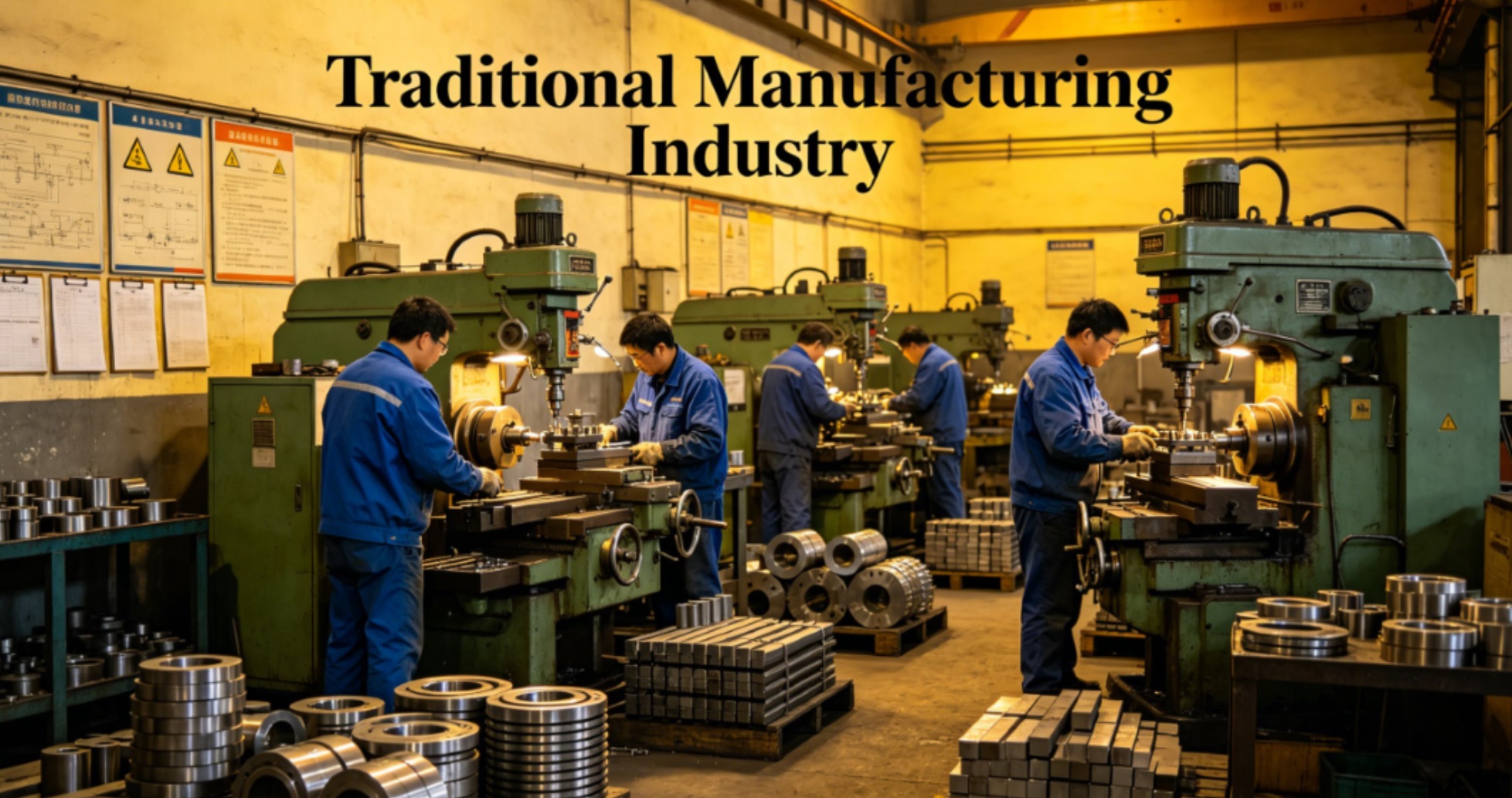
Traditional Manufacturing Industry Insights 2026–2030: From "Stability Cornerstone" to "New Value Engine"
— Guidelines for the Application of the Corporate Growth Engine System Solution
I. Industry Landscape: Strategic Return of the Fundamental Base & Window for Transformation
2026 marks a pivotal turning point for traditional manufacturing. In recent years, industrial policies once prioritized emerging industries over traditional ones—but this year, the approach has undergone a fundamental shift.
1. Reshaped Strategic Positioning: From "Supporting Role" Back to "Stability Cornerstone"
- Over 80%: The absolute fundamental base: Data shows traditional industries account for more than 80% of China’s manufacturing sector. Textiles, metallurgy, chemicals, machinery and others act as the "stabilizer" for economic growth and the "reservoir" for employment. In the first three quarters of 2025, the secondary industry’s value-added grew by 4.9% year-on-year, contributing 35.9% of GDP and consolidating the foundation of the real economy.
- Top priority for the 15th Five-Year Plan launch: The 2026 Government Work Report lists "optimizing and upgrading traditional industries" as the primary task under "accelerating the cultivation and expansion of new growth drivers." This sends a clear signal: traditional industries are not "low-end industries," but the main battlefield for developing new-quality productive forces. Experts emphasize that old and new growth drivers are not mutually exclusive—transforming and upgrading traditional industries is itself a core path to advancing new-quality productive forces.
2. Global Landscape: Deepening Divergence, China Faces Dual Pressures
- According to forecasts by the China Electronics Technology Group Corporation (CETC), global manufacturing will see sluggish growth in 2026, with strong demand in high-end manufacturing while traditional industries grapple with overcapacity and multiple pressures.
- Geopolitical tensions and trade barriers continue to escalate, alongside rising green barriers (e.g., carbon footprint accounting), creating compliance challenges for China’s traditional manufacturing exports.
II. Core Challenges: "Three Major Hurdles" in the Transformation Era
1. Misallocation of Resources: "Favoring the New, Ignoring the Old"
- Some local governments prioritize emerging industries over traditional ones, and favor new investment projects over existing industrial upgrades in policy and resource allocation. This leaves traditional enterprises lacking targeted support, with transformation momentum mismatched with capabilities. Traditional businesses often find themselves "wanting to transform but lacking funds and policy support."
2. Product Homogenization & Weak Branding
- Overreliance on the OEM model has led to severe product homogenization and cutthroat price competition. Zhao Wanping, a National People’s Congress (NPC) deputy, notes that China’s consumer base is undergoing generational shifts, with demand becoming increasingly diverse and personalized. Traditional capacity advantages and OEM models can no longer align with rapidly evolving consumption trends.
- Brand influence remains weak; most enterprises still compete on labor rather than technology, squeezing profit margins significantly.
3. Structural Talent Gap — "Machines Upgrade, People Fall Behind"
- This is the most critical pain point for traditional manufacturing. During research, Dong Mingzhu, Chairperson of Gree Electric, found that "automation equipment is deployed rapidly, but interdisciplinary technical talent lags, leaving production line efficiency underutilized".
- Frontline skilled workers are mostly labor-intensive operators, while there is a severe shortage of interdisciplinary talent (proficient in processes, data and AI) required for smart manufacturing and green development. The Ministry of Human Resources and Social Security projects a 4.5 million talent gap in smart manufacturing alone by the end of 2025.
- Vocational education lags industrial upgrading, with university-enterprise cooperation limited to superficial partnerships rather than deep integration.
III. Sustainable Development Solutions: Digital-Intelligent, Green & High-End Transformation
Against these challenges, leading enterprises and policymakers have reached a consensus: reshaping traditional industries through "three transformations".
1. Digital-Intelligent Transformation: From "Point Applications" to "Full-Chain Restructuring"
- In 2025, China’s core AI industry exceeded RMB 1.2 trillion, with over 30% of large-scale manufacturing enterprises adopting AI technologies.
- Case: Xi’an XD High Voltage Switchgear. Leveraging industrial software, its production scheduling system enables intelligent decision-making, boosting efficiency by 25%–40% and achieving an order fulfillment rate of over 98%.
- Case: Rizhao Steel (Shandong). By introducing algorithm models, the company codified veteran workers’ expertise into large AI models for "algorithmic steelmaking." With over 700 process models, intelligent quality inspection upgrades save more than RMB 8 million annually.
2. Green Transformation: From "Environmental Burden" to "Green Wealth"
- The Ministry of Industry and Information Technology (MIIT) has certified 8,336 green factories, accounting for 22% of total manufacturing output.
- Case: Rizhao Steel’s "Cross-Industry Symbiosis". The company recycles and purifies CO₂ from steelmaking for reuse in furnaces and builds customer loyalty through "technology partnership" strategies using blast furnace slag.
IV. Growth Engine System Solution: Break Through Barriers & Drive Value Leap
1. External Breakthrough via Change Quotient (CQ): Secure "Green Passports" & Solution Leadership
Challenge: Product homogenization, price wars, and failure to address deep customer needs.
Growth Engine Solution:
- Solution-Based Marketing Workshop: Train frontline teams to shift from selling products to delivering integrated smart manufacturing solutions. Help clients identify productivity and energy pain points and provide customized digital-intelligent and green transformation services.
- Enhance Change Quotient: Navigate carbon footprint barriers in global expansion by fostering a "community of interests" mindset with overseas clients. Leverage digital technologies to build digital product passports, strengthen carbon accounting capabilities, and secure green passes for global trade.
2. Internal Empowerment: Cultivate Talents as Corporate Growth Catalysts
Challenge: Frontline workers lack diverse skills, veteran expertise is hard to pass down, and interdisciplinary talent is scarce.
Growth Engine Solution:
- Growth Catalyst Training Camp: Following NPC deputy Cao Hui’s "New Era Artisan Vocational Education Restructuring Initiative", select technical and business leaders to train interdisciplinary internal catalysts proficient in processes, data and AI.
(a) Knowledge empowerment: Cover cutting-edge topics including Industrial Internet, large AI models, algorithmic steelmaking and green manufacturing.
(b) Skill empowerment: Adopt Rizhao Steel’s approach to codify veteran expertise into AI models, training employees to become machine trainers and AI supervisors.
- Reskill "New Artisans": Responding to NPC deputy Feng Lichao’s proposal, improve incentives for skilled workers, implement a new eight-tier skilled worker system to reward higher skills with better pay, and use "work-study alternation" and "modern apprenticeships" to translate skill upgrades into income growth.
3. Integrated Leapfrog Development: Cross-Functional Collaboration, Creative Leadership & Human-Machine Collaboration
Challenge: Siloed departments, data fragmentation, disconnect between production and marketing, and underutilized line efficiency.
Growth Engine Solution:
- AI + Manufacturing Practical Lab
(a) Cross-departmental collaboration: Form agile teams comprising IT, OT (Operational Technology), production and sales to design industrial data sharing and governance frameworks that break down silos. Draw on Xi’an XD High Voltage Switchgear’s experience to advance intelligent production scheduling.
(b) Human-machine collaboration: Leverage AI agents to automate data entry and repetitive tasks, freeing employees for high-value decision-making. For example, Rizhao Steel’s robotic unmanned temperature measurement and sampling allow workers to transition into process optimization specialists.
- Creative Leadership Development
(a) Strategic consensus workshop: Cultivate long-term thinking in core teams amid a "transform or perish" era. As TCL Chairman Li Dongsheng emphasized, support for high-tech, capital-intensive, long-cycle industries requires patience and discipline. Dong Mingzhu advises entrepreneurs to "stay grounded, avoid empty concepts, and refrain from chasing quick gains".
(b) Empowerment for scenario definition: Following leading enterprises’ examples, encourage collaboration between businesses and research institutes to build joint laboratories, tackle core technologies (e.g., aluminum-based composite materials), let enterprises define technical requirements, and shift policy focus from upfront R&D subsidies to opening downstream application scenarios.
Conclusion
Traditional manufacturing in 2026 is no longer a sunset industry—it is a fertile ground for nurturing new-quality productive forces. The Growth Engine solution helps enterprises secure green passes and solution leadership via CQ-driven breakthroughs, resolves the "machine upgrade without talent upgrade" structural gap through talent development, and breaks data silos to build a new paradigm of human-machine collaboration via cross-industry integration. It not only addresses the current "fear to transform, reluctance to transform" impasse but also builds irreplicable core capabilities for global manufacturing competition over the next decade.
Research Sources
1. 21st Century Business Herald. NPC Deputy Zhao Wanping: Anchor Supply Chain Value Leap, Integrate Digital and Real Economies to Drive Industrial Momentum. Mar 12, 2026
2. China Workers’ Net. Optimizing and Upgrading Traditional Industries | Resource Aggregation Forges New Industrial Advantages. Mar 24, 2026
3.China Textile News. NPC Deputy Feng Lichao: Focus on Skilled Talent Cultivation and Tax Reform to Reduce Burdens, Support Traditional Manufacturing Transformation. Mar 10, 2026
4. Sina Finance. 2026 Global Manufacturing Development Outlook. Dec 31, 2025
5. China Workers’ Net. From Digital-Intelligent Transformation to Upholding Long-Termism — NPC Deputies on Manufacturing Upgrading. Mar 9, 2026
6. Xinhua News Agency Economic Daily. Resource Aggregation Forges New Industrial Advantages. Mar 24, 2026
7. China Economy. Hardcore Technology Forges "High-Precision-Advanced" Products, Traditional Industries Accelerate Toward "Intelligence" and "Green" with New Combinations. Mar 14, 2026
8. China Daily. CPPCC Member Cao Hui: Propose Launching "New Era Artisan Vocational Education Restructuring Initiative" to Reserve One Million Young Artisans for High-End Manufacturing. Mar 16, 2026