
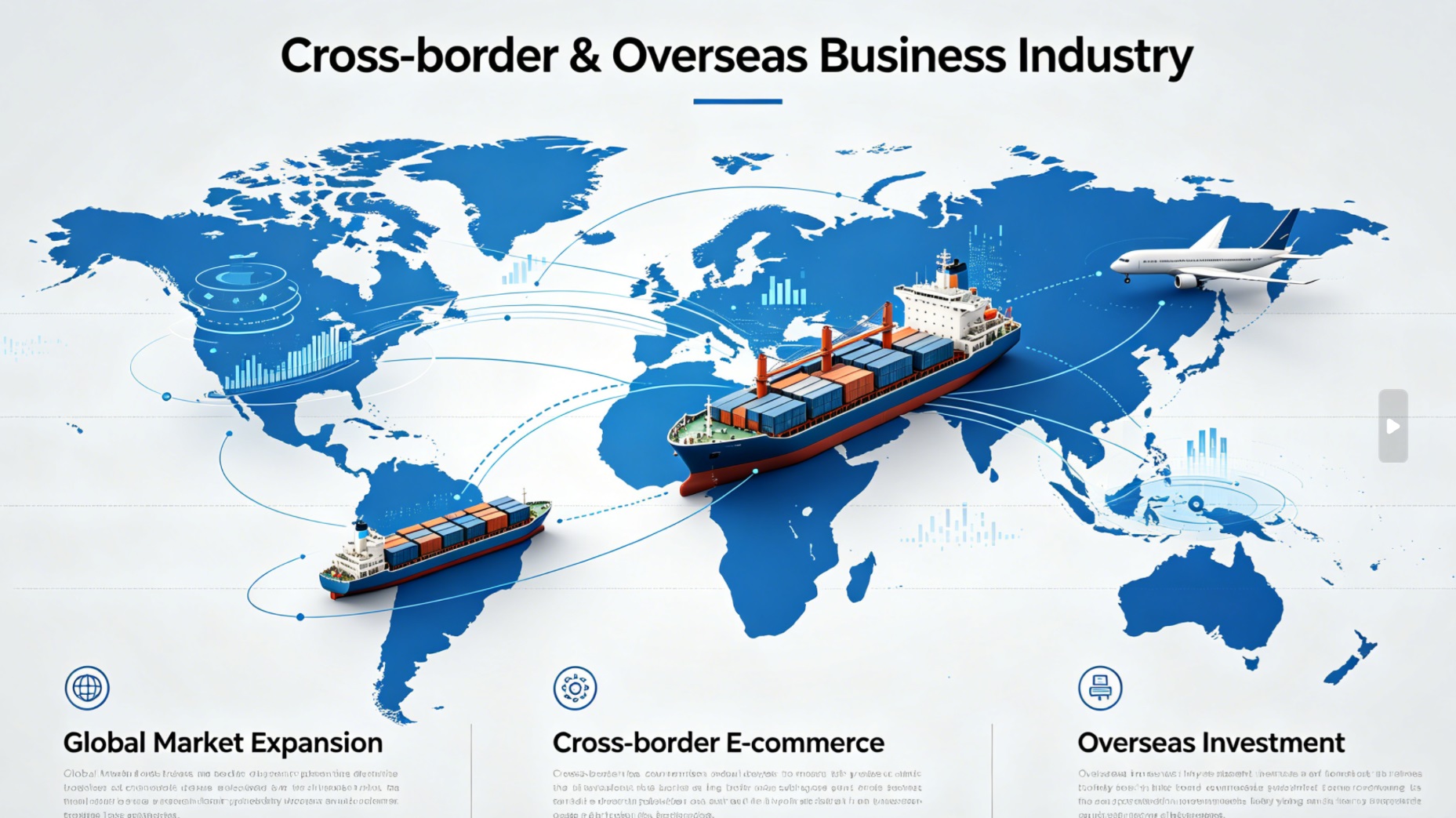
Cross-border & Overseas Business Industry Insights 2026–2030: Leap from Product Export to Systematic Capability Export
— Guidelines for the Application of the Corporate Growth Engine System Solution
I. Industry Landscape: Global Restructuring & In-depth Integration of Chinese Enterprises
2026 marks a brand-new phase for Chinese companies going global. Macroeconomic data reflects this trend: China’s outward foreign direct investment (OFDI) reached USD 174.38 billion in 2025, a year-on-year increase of 7.1%. By the end of 2025, Chinese enterprises had set up more than 50,000 overseas subsidiaries across over 190 countries and regions. China’s outward investment stock has ranked among the world’s top three for nine consecutive years.
1. Fundamental Shift in Overseas Expansion Logic: From Isolated Layout to Industrial Chain Expansion
Chinese enterprises are upgrading from simple goods trade to integrated industrial and supply chain expansion. As Wei Jianguo, former Vice Minister of Commerce, noted at the 2026 Global South Financiers Forum, Chinese firms have evolved from scattered single factories and standalone projects to cluster-based overseas deployment. They now prioritize industrial chain clustering, supply chain collaboration and localized operation. The model of Chinese Technology + Global Innovation + Localized Services has gained wide recognition worldwide. Through integrated investment and trade layout, enterprises achieve deep integration of production-for-local-sale and local-production-for-export.
2. Diversified Destinations: Emerging Markets Become Main Battlefields
Markets across Southeast Asia, the Middle East, Latin America, Africa and other regions of the Global South have become core destinations for overseas expansion. Research by CICC shows that Southeast Asia remains the primary choice, with steady growth in greenfield investment. Meanwhile, enterprises attach greater importance to strategic planning. The integrated overseas expansion model pioneered by Chengfa Environment has become a benchmark: cultivating key countries, engaging governments at a high level, and leading development with competitive industries, setting a model for comprehensive solid waste management.
3. Upgraded Capability Export: From Selling Products to Delivering Services and Standards
Li Wei, Chairman of Jiahua Technology, pointed out at the forum that the core of going global lies in capability export. Jiahua Technology is systematically exporting its dual-carbon expertise: assisting Malaysia in establishing MRV certification systems and cross-border carbon trading mechanisms, and supporting Thailand to build carbon footprint platforms to comply with the EU Carbon Border Adjustment Mechanism (CBAM). This demonstrates that Chinese enterprises are shifting from product export to the delivery of services, solutions and even industrial standards.
II. Core Challenges: Structural Gaps Between Global Ambitions and On-the-ground Execution
1. Surging Compliance Costs: The Top Lifeline
Yuan Xin, President of SAP Greater China, stated at the 2026 Globalization Summit that compliance costs have skyrocketed. Cumulative fines under the EU GDPR have exceeded RMB 70 billion, while Brazil’s tax regime comprises over 90 different types of taxes. Without proactive compliance systems, enterprises will face existential risks of being locked out of markets. Additionally, the EU has signed a EUR 76.75 million guarantee agreement with the European Bank for Reconstruction and Development to promote ESG adoption across supply chains, further raising market entry thresholds.
2. Mismatch Between Organizational Capacity and Overseas Expansion Pace
Deloitte’s reports indicate that the key challenges for overseas businesses have shifted from market assessment to systemic issues including insufficient organizational collaboration, cross-cultural integration difficulties and inadequate local governance. Roland Berger’s research reveals two prevalent pain points: weak local adaptation (overreliance on extensive general agent models for sales, and R&D decoupled from local demands) and outdated governance (domestic management practices triggering frequent cross-cultural conflicts).
Based on years of service experience, Jinyuan Chengyou found that many overseas setbacks stem not from isolated capability deficits, but structural mismatch between capacity building and development stages. Applying a uniform management model across the startup and scaling phases leads to internal resource waste and efficiency losses.
2. Underdeveloped Financial Infrastructure & Global Execution Difficulties
Cross-border operations face exponentially rising complexity in payment systems, monetary regimes and regulatory requirements. According to a report released by Airwallex during the 2026 Davos Forum, every country brings unique frictions in payment, currency, entity management, regulation and reconciliation, creating a huge divide between global aspirations and practical execution. Statistics show that 90% of enterprises encounter payment and operational hurdles, as traditional financial systems lack real-time visibility and standardized workflows.
4. Non-tariff Barriers in Trade in Services: A Blind Spot for Executives
Latest research by Boston Consulting Group (BCG) highlights an overlooked risk for CEOs: non-tariff restrictions on cross-border services. Global trade in services is projected to grow twice as fast as goods trade, reaching USD 11.7 trillion by 2032. Nevertheless, countries are rolling out new trade barriers via digital services taxes, data localization mandates, export controls and restrictions on foreign service providers. Such measures inflict heavier impacts than tariffs: companies may resume operations after paying tariffs, while service providers can be permanently excluded from markets.
III. Sustainable Development Solutions: From Going Global to Rooting Locally
1. Phased Layout for Capability Export
The underlying logic of overseas expansion is transforming from opportunity-driven to capability-driven. Jinyuan Chengyou proposed a clear phased roadmap for capability development:
- Startup Phase: Focus on market evaluation and risk prevention
- Growth Phase: Strengthen organizational development and cross-cultural management
- Maturity Phase: Build standardized systems and scalable replication capabilities
- Optimization Phase: Run throughout all stages to form a dynamically iterative capability loop
2. Dual drive of AI and Compliance
To adapt to fragmented global markets, enterprises need a unified data semantic layer to align with regulations across more than 180 countries and regions. SAP’s practices prove that compliance is not merely a cost, but a market entry ticket for globalization. A robust compliance framework turns uncertainties into differentiated competitive edges. Meanwhile, AI can automate 60% to 70% of repetitive financial tasks including payment optimization, fraud detection, reconciliation and settlement, enabling continuous financial operations and easing end-of-month workloads.
3. Ecosystem Collaboration to Build a Closed-loop Overseas System
Overseas expansion has entered an era of refined operation, where standalone strengths can no longer sustain global competition. Leading enterprises adopt a dual model of strategic collaboration + on-site empowerment. By integrating overseas recruitment, Employer of Record (EOR), payroll services and talent training, they create a full-value chain covering organizational development and compliance implementation, forming a closed loop linking talent growth and business delivery.
4. Integration of Supply Chain, Trade and Investment
Muyuan Foodstuff has adopted a two-phase progressive internationalization strategy. It starts with light-asset technical cooperation including pig farm design, biosecurity solutions and personnel training, before launching heavy-asset projects. Its high-rise pig farm project in Vietnam, with an annual output of 1.6 million hogs, effectively mitigates overseas risks via the light assets first, heavy assets follow approach.
IV. Future Development Trends
Trend 1: From Product Export to Systematic Capability Export
Yuan Xin from SAP summarized three major transformations for Chinese global enterprises: shifting from standalone factories to multi-node production networks, from one-off transactions to long-term service models, and from traffic monetization to refined user asset management. In the future, global competitiveness will hinge on deep AI integration across businesses to realize data-driven intelligent operations worldwide.
Trend 2: AI Agents Reshape Global Operations
AI is evolving from a supporting tool to an integrated value creator. Gartner forecasts that over 40% of standalone AI projects will be phased out by 2027, while successful adopters will gain substantial competitive advantages. AI is designed to free staff from repetitive work and enable them to focus on high-value business creation. In finance, Autonomous Finance will become a new competitive edge, featuring intelligent payment routing, real-time reconciliation and dynamic capital management.
Trend 3: RMB Internationalization & Improved Financial Access
Tong Jisheng pointed out that accelerating RMB internationalization enhances the diversity and stability of the global financial system, and delivers more convenient, secure financial channels for Chinese cross-border traders and investors. It will greatly reduce exchange rate risks and transaction costs for overseas businesses.
Trend 4: Green Transition as a Global Market Passport
Under the EU Global Gateway strategy, ESG standards have become mandatory entry requirements for international markets. The guarantee agreement between the EU and the European Bank for Reconstruction and Development explicitly supports SMEs in adopting best environmental, social and governance practices to boost competitiveness and resilience. Enterprises without green capabilities will struggle to compete globally.
V. Gaps Between Current Status and Future Goals: Organizational Capacity as the Core Bottleneck
|
Dimension |
Current Status |
Future Goals |
Core Gaps |
|
Business Model |
Single product trade & OEM |
Solution delivery, service-oriented & platform-based operation |
Value creation: Lack of systematic capabilities to shift from product sales to capability export |
|
Compliance Capability |
Passive response & post-event remedies |
Proactive defense embedded in business workflows |
Compliance strategy: Failure to recognize compliance as a value center rather than a cost center |
|
Organizational Capacity |
Copy of domestic management models & frequent cross-cultural conflicts |
Localized governance, agile collaboration & stage-matched capabilities |
Talent gap: Shortage of interdisciplinary talents familiar with local markets, business and management |
|
Technology Application |
Tool-based assistance & manual-driven operations |
Collaborative AI agents, autonomous decision-making & human-machine integration |
Digital & intelligent integration: Insufficient deep fusion between AI and business processes |
|
Risk Management |
Focus on traditional risks such as tariffs |
Full coverage of non-tariff barriers in trade in services |
Cognitive blind spot: Inadequate foresight on emerging risks including data localization and digital services tax |
|
Financial Infrastructure |
Fragmented systems & manual reconciliation |
Integrated global payment & real-time capital management |
Execution gap: Isolated systems and low efficiency in cross-currency and cross-market operations |
VI. Action Roadmap: Drive Sustainable and Steady Growth
To tackle the above challenges, overseas enterprises need more than strategic resolve — they require systematic restructuring of organizations and talent teams. This is where the Growth Engine training and micro-consulting solution delivers core value.
1. External Breakthrough via Change Quotient: Create New Value
Challenge: Stuck in price wars, unable to reach high-value overseas clients, with weak brand and capability export.
Growth Engine Solutions:
(a) Solution-Based Marketing Workshop: Train frontline teams to shift from selling products to delivering services, professional capabilities and integrated solutions. Drawing on Jiahua Technology’s experience in building carbon market systems and carbon footprint platforms overseas, guide teams to identify underlying demands of government bodies and large enterprises such as compliance and low-carbon transformation, and deliver packaged solutions combining technology, services and standards.
(b) Enhance Change Quotient: Equip teams to handle cross-cultural communication, policy uncertainties and ESG compliance by fostering a community-of-interests mindset with overseas governments and local partners. Learn from Chengfa Environment’s high-level government engagement model to establish top-level communication mechanisms and deliver holistic solutions, upgrading teams’ capabilities in negotiation and resource integration.
2. Internal Empowerment: Cultivate Talents as Corporate Growth Catalysts
Challenge: Mismatched capacity building and expansion stages, severe shortage of cross-cultural management talents and serious internal friction.
Growth Engine Solutions:
(a) Growth Catalyst Training Camp: Adopt Jinyuan Chengyou’s phased empowerment framework to select core business and technical staff, and build a full spectrum of capabilities tailored to different overseas stages:
- Preparation phase: Strategy decomposition and risk assessment
- Launch phase: Organizational design and responsibility allocation
- Pilot phase: Cross-cultural conflict resolution and team management
- Scaling phase: Standard system establishment and replication
- Optimization phase: Value accumulation and organizational learning
(b) Upskill New Overseas Professionals: Provide targeted training for expatriates covering cultural adaptation, mental resilience and professional competency. Refer to the integrated working model of task forces, post-based management and project-based operation to transform management from manual control to system-driven operation and improve execution efficiency.
3. Integrated Leapfrog Development: Cross-functional Collaboration & Creative Leadership
Challenge: Siloed departments, data fragmentation, poor collaboration between headquarters and overseas teams, and disconnection between AI and business workflows.
Growth Engine Solutions:
(a) AI + Global Operations Practical Lab
- Cross-departmental collaboration: Form agile teams consisting of IT, finance, legal and overseas business leaders to develop integrated solutions for fragmented cross-border payment and data localization compliance. Follow SAP’s unified data semantic layer concept to break down data silos between domestic and overseas businesses and realize real-time global visibility.
- Human-machine collaboration: Deploy AI agents to handle repetitive work in finance, compliance and customer service. Deloitte’s survey shows 87% of CFOs regard AI as extremely vital to financial operations. Train employees to evolve from operators to AI supervisors and exception handlers.
(b) Creative Leadership Development
- Strategic consensus workshop: Cultivate long-term thinking among core teams amid a transformative era. As Tong Jisheng emphasized, enterprises must focus on core businesses, build irreplicable core strengths, and upgrade from isolated advantages to integrated industrial strengths.
- Decision-making capabilities for anticipation, mitigation and transformation: Adopt BCG’s four-step framework for executives:
① Expand trade command centers to cover trade in services;
② Mitigate cost impacts via automation and flexible pricing;
③ Restructure global models from centralized platforms to modular regional frameworks;
④ Engage proactively with policymakers to participate in rule-setting.
Conclusion
Overseas expansion in 2026 is no longer simple market exploration, but the systematic export of core corporate capabilities. The shifts — from product export to systematic capability export, from opportunity-driven to capability-driven growth, and from standalone operation to ecosystem collaboration — require simultaneous upgrades in strategy, organization, talent and technology.
The Growth Engine solution helps enterprises seize the high ground of solution and standard export via Change Quotient-driven breakthroughs, resolves the structural mismatch between capabilities and development stages through talent empowerment, and breaks data silos to build a new human-machine collaboration paradigm via cross-functional integration. It not only addresses challenges in the deep waters of global expansion today, but also forges irreplaceable core strengths for global competition over the next decade.
Research Sources
1. Sina Finance. Tong Jisheng, President of China Association of Foreign Trade and Economic Cooperation: The Fundamental Solution to Changes Is to Enhance Internal Strength and Build Irreplicable Core Competencies. Mar 24, 2026
2. Sina Finance. Exploring New Paths: Enterprises Shall Shift from Product Export to Service and Solution Export. Mar 25, 2026
3. Beijing Youth Daily Finance. Jinyuan Chengyou Launches Overseas Training & Consulting Services to Build Integrated Overseas Ecosystem. Feb 6, 2026
4. Davos 2026: Global Ambitions Are Easy, Global Delivery Is Hard. Jan 23, 2026
5. Shanghai Securities News. New Opportunities & Challenges: Overseas Roadmap Amid Global Restructuring — Sub-forum of 2026 Global South Financiers Forum Held in Beijing. Mar 25, 2026
6. CCIDNet. New Overseas Model: AI + Compliance for Resilient Growth. Mar 24, 2026
7. News Brief. Sanhui Consulting Empowers Foreign Trade Enterprises and Unleashes New Growth Momentum. Dec 29, 2025
8. WITA. Global Trade Shifts That May Catch CEOs Off Guard. Jan 26, 2026
9. Beijing Municipal Bureau of Commerce. EU and EBRD Jointly Promote Corporate Green Transition. Feb 2, 2026