
Development and Opportunities for Trainers in the Internet Era
August 28, 2016 | Excerpted from: Jian Shu | Interviewee: James Chin
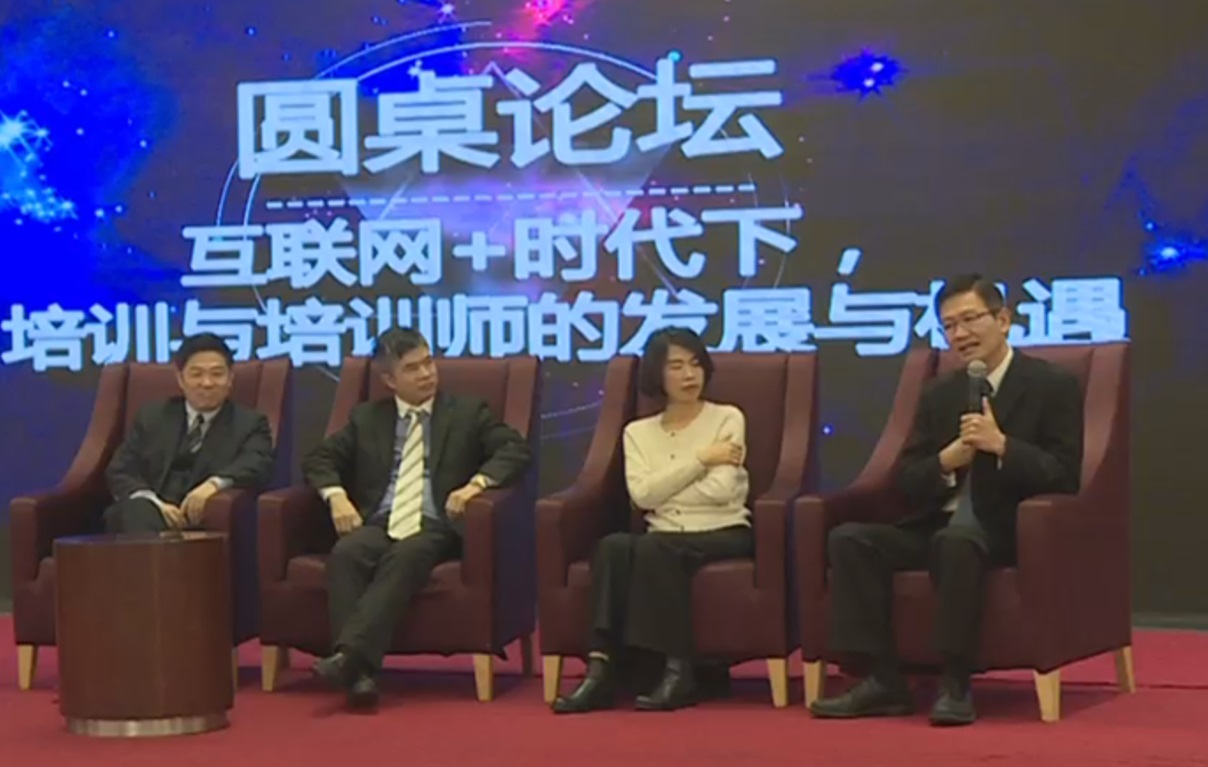
I gained tremendous insights at the 14th Annual Summit of CIIC CIPMT International Professional Trainers. During the afternoon roundtable forum themed Development and Opportunities for Training and Trainers in the Internet Plus Era, I listened to in-depth discussions among many distinguished industry experts and compiled notes to share with everyone.
At the start of the session, host Justin introduced the four panel guests by categorizing them into two sides of the industry: the service provider side and the client side. The lineup included freelance professional trainers who deliver training services, corporate training directors responsible for purchasing external training courses, and executives of training institutions who wear both hats — they run training organizations while also procuring various courses to enrich their product portfolios. As seasoned practitioners and thought leaders representing both buyers and sellers in the training market, all guests offered unique perspectives on the questions raised by host Justin.
One of the distinguished guests was Mr. James Chin, President of the Singapore International Consulting and Training Centre. He also serves as the Lead Mentor and Consultant for the UK IPMA Certified International Professional Trainer (CIPMT) Program. Over the years, he has cultivated more than 1,700 professional international trainers across the Asia-Pacific region and previously held the position of President of the Singapore Association of International Professional Trainers.
The host raised the first question: Given the rapid advancement of internet technology, what changes do you foresee for the training industry over the next five years?
Guest A: Internet technologies represented by VR (Virtual Reality) will become a key direction for exploring new training models. Nevertheless, we will not witness drastic shifts in the short term. It is worth noting that people tend to overestimate the short-term impact (within 3 to 5 years) of technology on traditional industries yet underestimate its revolutionary disruptive power in the long run (8 to 10 years and beyond).
Guest B: Internet technology is merely a tool. It can never fully replace human trainers fundamentally.
Guest C (James Chin): The internet has made information far more accessible. In the future, trainers who only focus on knowledge dissemination will be replaced by technology. That said, this is not necessarily a bad thing. There are three stages for trainers to help learners attain wisdom: acquiring knowledge through listening, gaining understanding through reflection, and achieving enlightenment through practice. Currently, internet technology is capable of supporting the first two stages, but it cannot accomplish the third — enlightenment rooted in real-world practice and experience. Therefore, technological progress will push many trainers to shift their role from information deliverers to facilitators of wisdom growth, focusing on guiding learners to reach the stage of practical enlightenment. Meanwhile, internet technology can serve as a powerful aid throughout this process.
Host Justin: Undoubtedly, internet technology brings great convenience and cost reduction. The true value of trainers lies in delivering what technology cannot instill in learners. Here is the second question: What content and communication must be delivered through face-to-face interaction between trainers and trainees?
Guest A: People often say knowledge is power, but that is not entirely true. Knowledge itself is not power; the ability to apply knowledge is. As mentioned by previous speakers, "Learning involves daily accumulation of knowledge" — a quote from Tao Te Ching. Today, however, we are overwhelmed by massive amounts of information. What we need is to cut through the noise and put knowledge into practice to truly make it our own. This aligns with the subsequent line from Tao Te Ching: "Cultivating the Dao involves daily reduction."
Learning brings daily increase; cultivating the Dao brings daily decrease. Decrease again and again, until one reaches the state of non-action. With non-action, nothing is left undone. Knowledge can be acquired via the internet, yet the strength forged through practical application requires human guidance.
Guest B: Even a sophisticated system like AlphaGo cannot completely take the place of top Go players. The complete stimulus-response cycle can only be fulfilled by humans, not technology.
Guest C (James Chin): First of all, knowledge is derived from continuous practice and refinement before it can be passed on. This process cannot be replaced by technology. Secondly, learning is a collaborative journey between trainers and trainees. Knowledge and insights are shared and absorbed through professional guidance and interactive communication — another role exclusive to humans.
Guest D: Humans create technology, yet we must never be controlled by it. For instance, trainers use PPT as a teaching aid, but everyone understands that the trainer, rather than the slides, should always be the core of a class.
Host Justin: Humans differ from machines in three key aspects. First, humans can engage in random or even trivial thoughts, such as wondering what to eat for lunch, while machines cannot. Second, humans actively seek real-life experiences, which is beyond the capability of machines. Third, humans are able to endow things with meaning, pass on such perceptions and inspire others to make positive changes — a function that machines will never achieve. Here comes the final question: Looking ahead to the new year, if you had to learn something unrelated to training in the coming year, what would you choose?
Guest A: I would study Buddhism and philosophy, seeking spiritual guidance. As I turn forty, I embrace the ancient Chinese saying: "At forty, one is free from perplexities." At this stage of life, I hope to better understand the world, and live in harmony with myself and everything around me.
Guest B: I would learn Tai Chi to keep fit and maintain good health.
Guest C (James Chin): I want to learn how to better adapt to constant changes in the world. Since my core courses focus on navigating transformation, I believe I need to keep learning and improving myself first. Only by growing stronger can I better help my trainees make progress.
Guest D: I plan to sharpen my problem-solving skills. Solving real-world problems hands-on brings more tangible fulfillment than just teaching others the methods. Besides, I hope to deepen my understanding of truth, goodness and beauty, especially the pursuit of aesthetic realms.
The above is merely my personal notes and interpretation. Corrections and supplementary information are warmly welcomed for any omissions or inaccuracies. Thank you!